You're looking at a 10-subject syllabus covering algorithms, operating systems, theory of computation, compiler design, computer networks, databases, computer architecture, digital logic, engineering mathematics, and data structures — all for a single exam. That's GATE CS, and choosing the wrong course wastes months you cannot recover. A structured GATE CS course converts that overwhelming list into a sequenced, measurable preparation path. This guide covers what belongs inside a good course, what the fees look like across formats, and how to evaluate any program before you invest your time and money — so you are prepared for GATE CS 2028, not just registered for it.
According to the official GATE CS 2026 results published by IIT Guwahati, 2,11,020 candidates appeared and only those above 30 marks (General/EWS) received a valid scorecard — yet the scores needed for IIT admissions start at 55+ marks. That gap between qualifying and admission-competitive only closes with disciplined, syllabus-aligned preparation.
Also Read: What is GATE CSE? Full Form, Exam Pattern & Career Scope

What Is a GATE CS Course and Who Should Take It?
A GATE CS course is a structured coaching program covering the full GATE Computer Science and Information Technology syllabus — including Engineering Mathematics, Algorithms, Theory of Computation, OS, DBMS, Computer Networks, COA, Compiler Design, Digital Logic, and Programming and Data Structures — designed to help candidates score high enough for IIT/NIT admissions or PSU recruitment.
GATE CS 2027 is organised by IIT Madras. With 2,59,922 registered candidates in 2026, it is the most competitive GATE paper by candidate volume. A GATE CS course is specifically for you if:
- You are targeting IIT/IISc/NIT for M.Tech in Computer Science, AI, or Data Science.
- You want a PSU job where GATE CS scores are accepted in recruitment cycles.
- You are self-studying but need a structured framework to avoid syllabus gaps and sequencing errors.
- You scored below your target in a previous GATE CS attempt and need a reset with better fundamentals.
- You are a working professional targeting GATE CS 2028 alongside your job.
The GATE CS qualifying cutoff for General category candidates was 30.0 marks in 2026, 29.2 in 2025, and 27.6 in 2024 — but IIT admissions require consistently 65+ marks. That gap is not closed by reading textbooks; it is closed by solving problems at GATE difficulty with time pressure. Structured courses are built to create that environment.
Also Read: GATE CSE Cutoff — Qualifying Marks and IIT Admission Score Requirements
What Does a GATE CS Course Syllabus Cover?
A quality GATE CS course covers all 10 subject sections: Engineering Mathematics, Digital Logic, COA, Programming and Data Structures, Algorithms, Theory of Computation, Compiler Design, Operating Systems, Databases, and Computer Networks. Engineering Mathematics is fixed at 13 marks; General Aptitude at 15 marks; the remaining 9 CS sections share 72 marks. No fixed per-section CS marks are published.
Understanding this structure helps you evaluate any course immediately — ask whether any of these 10 sections are absent or underrepresented.
Engineering Mathematics (13 marks, fixed)
This is the highest-certainty marks block in GATE CS. A good course covers:
- Discrete Mathematics — Graph theory (connectivity, Euler/Hamiltonian paths, graph colouring, spanning trees), propositional and first-order logic, combinatorics, recurrence relations, set theory, groups.
- Linear Algebra — Eigenvalues, eigenvectors, system of linear equations, rank, nullity.
- Probability and Statistics — Conditional probability, Bayes' theorem, binomial, Poisson, exponential distributions, expected value, variance.
- Calculus — Limits, continuity, differentiation, maxima/minima, mean value theorem.
A GATE CS course that treats Engineering Mathematics as an afterthought is one to avoid. Scoring 11–12 out of 13 in Engineering Mathematics with 4 weeks of preparation is reliably achievable — it is the highest return-on-investment subject in the paper.
Also Read: GATE CSE 2027 Important Topics — Subject-Wise High-Frequency Topics
Algorithms, Data Structures, TOC, OS, and DBMS
The core CS subjects that produce the most 2-mark and NAT questions. A syllabus-aligned GATE CS course must cover:
- Algorithms and DS — BFS/DFS, Dijkstra, Bellman-Ford, Floyd-Warshall, Kruskal, Prim; merge sort, quick sort (worst-case), heap sort; AVL trees, B-trees, binary heaps; dynamic programming (LCS, knapsack, matrix chain); Master theorem; hashing (open addressing, chaining).
- TOC — DFA/NFA construction, minimisation, regular expressions, pumping lemma (regular and CFL), PDA, Turing machines, decidability, Rice's theorem, P vs NP.
- Operating Systems — CPU scheduling algorithms (FCFS, SJF, Round Robin — numerical), page replacement (FIFO, LRU, Optimal — numerical), Banker's algorithm, inode file system, disk scheduling.
- DBMS — SQL with JOINs and nested queries, normalisation (1NF–BCNF), functional dependencies, B+ tree operations, serializability and concurrency control.
- Computer Networks (2027 syllabus) — Distance-vector routing, link-state routing, IPv4/CIDR/NAT, TCP congestion control, sliding window throughput, CRC, DNS, HTTP.
Use the official GATE CS 2027 syllabus PDF from IIT Madras to verify any course's coverage against the current syllabus. For GATE CS 2028, the 2027 syllabus is the best available baseline until the 2028 notification is published.
Also Read: GATE CSE Syllabus 2027 — Complete Topic Breakdown
How Do You Choose the Right GATE CS Course?
The right GATE CS course has four non-negotiable features: complete 10-subject syllabus coverage with concept-first teaching, regular full-length mock tests with performance analytics, strong numerical problem-solving practice (OS, COA, Networks), and responsive faculty from verifiable GATE/IIT backgrounds. Any structural gap here is a gap in your preparation.
Here is a practical evaluation framework to apply to any course before committing:
| Feature | What to Look For | Red Flag |
|---|---|---|
| Syllabus Coverage | All 10 GATE CS subjects covered, updated for current year | TOC, Compiler Design, or COA skipped or covered lightly |
| Teaching Style | Concept-first with derivation, followed by problem-solving | Formula dumps without explanation; only theory, no numericals |
| Mock Tests | Full-length timed mocks (at least 5–10) + subject-wise tests with analysis | Only topic quizzes; no full-length exam simulation |
| PYQ Coverage | Annotated solutions for GATE CS PYQs from 2018–2026 | PYQs listed but not solved or explained |
| Study Material | Updated for GATE CS 2027 syllabus changes (COA, CN, Digital Logic) | Material unchanged from pre-2027 syllabus; old CN topics included |
| Faculty Credentials | IIT alumni or verified GATE CS toppers | No verifiable academic or exam background |
| Demo Access | Free demo lectures available before purchase | No free trial; no sample content accessible |
The GATE CS coaching market in India is large and varied. Prices range from ₹4,000 for basic recorded video packages to ₹40,000+ for premium live coaching with mentorship and an integrated test series. Do not use price as the primary filter. Watch at least two free demo lectures on the subjects you find hardest (TOC or Compiler Design are good tests) before purchasing any course — if the instructor explains why a DFA minimisation works rather than just how to run the table-filling algorithm, the course will hold up under the exam's conceptual questions.
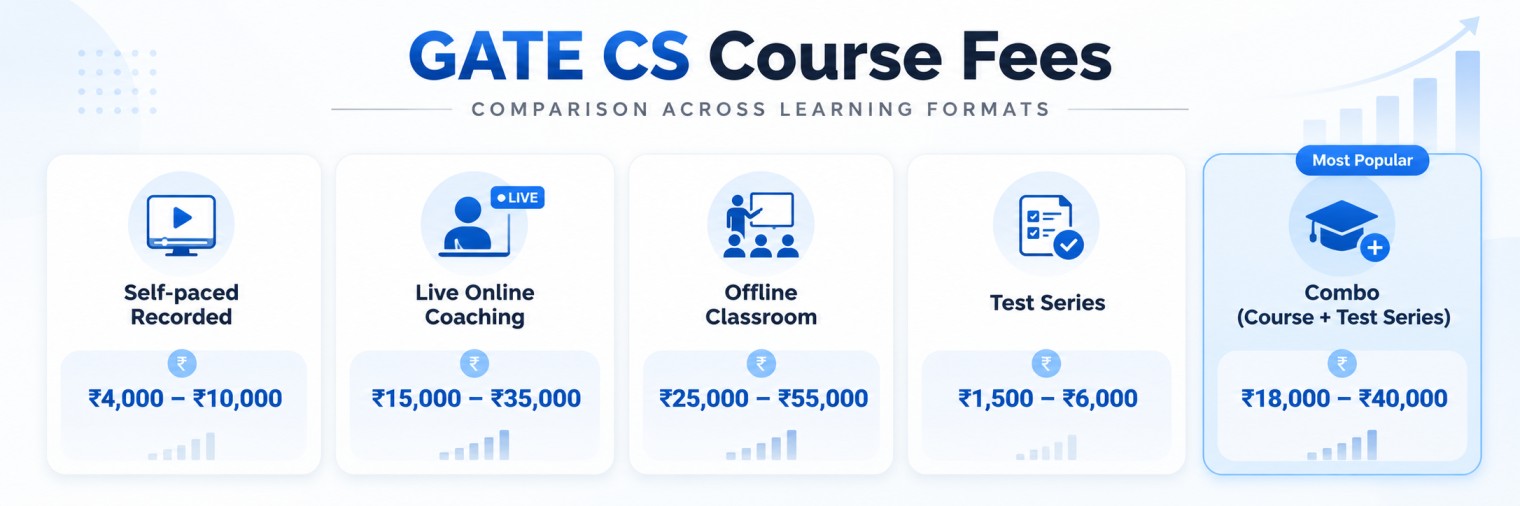
GATE CS Course Fees: What to Expect in 2026–2028
GATE CS course fees in India typically range from ₹4,000 for self-paced recorded courses to ₹40,000 for comprehensive live online coaching with mentorship and an integrated test series. Offline classroom programs can go higher.
| Course Type | Price Range | Best For |
|---|---|---|
| Self-paced recorded | ₹4,000–₹10,000 | Students with strong CS fundamentals |
| Live online coaching | ₹15,000–₹35,000 | Students needing structure, schedule, and doubt resolution |
| Offline classroom | ₹25,000–₹55,000 | Students who prefer in-person interaction and peer groups |
| Test series only | ₹1,500–₹6,000 | Students who have completed subject-wise preparation |
| Combo (course + test series) | ₹18,000–₹40,000 | Most aspirants targeting IIT or top-NIT admissions |
A cheaper GATE CS course is not necessarily worse. Strong courses exist in the ₹10,000–₹18,000 range. What matters more than price is whether the content reflects the current GATE CS syllabus (including 2027 changes to COA, Digital Logic, and Computer Networks) and whether the mock tests are genuinely full-length with analytical feedback — not just quiz banks.
Avoid courses that recycle older GATE CS content without updating for syllabus changes. The 2027 Computer Networks syllabus removes OSI model naming, ARP, DHCP, SMTP, FTP, and Ethernet bridging. A course still teaching these as active exam topics wastes preparation hours on removed material.
Also Read: GATE CSE 2027 Study Plan — Month-by-Month Schedule and Books
How to Prepare for GATE CS: A 5-Month Study Plan
Starting five months before the GATE CS exam — September to January for a February exam — gives enough time to cover all subjects once for concept-building and once for problem-solving and revision. Use the first four months for subject-wise preparation and the final month exclusively for revision and full-length mock testing.
- Month 1 — Engineering Mathematics and Digital Logic: Cover graph theory, probability, and linear algebra from Kenneth Rosen (Discrete Mathematics) and Sheldon Ross (Probability). Then complete Digital Logic: K-map minimisation, flip-flop state tables, combinational circuit design from Morris Mano. Solve 10 PYQs per topic on SuccessTracker immediately after each chapter.
- Month 2 — Algorithms and Data Structures: Cover CLRS for graph algorithms (BFS/DFS, Dijkstra, Kruskal), dynamic programming (LCS, knapsack), sorting, and asymptotic analysis. Build AVL trees, B-trees, and hashing problem-solving skills. Solve 15+ PYQs per topic — DSA has the most 2-mark NAT questions in the paper.
- Month 3 — TOC, Compiler Design, and COA: Cover Sipser for TOC (DFA minimisation, pumping lemma, decidability). Study Compiler Design from the Dragon Book (FIRST/FOLLOW, LL(1)/LR parsing). Cover COA from Stallings (pipelining, cache mapping, hardwired/microprogrammed control — the 2027 addition).
- Month 4 — OS, DBMS, and Computer Networks: Cover Silberschatz-Galvin for OS numericals (scheduling, page replacement, Banker's algorithm). Cover Silberschatz-Korth for DBMS (SQL, BCNF normalisation, B+ trees). Cover the 2027-scoped CN syllabus only — routing (DV/LS), IPv4/CIDR, TCP congestion, CRC, DNS, HTTP from Tanenbaum Ch. 4–6.
- Month 5 — Revision and Mock Tests: Subject-wise rapid revision in Weeks 1–2. Full-length timed mock tests (minimum 3) in Weeks 3–4. Analyse every wrong answer. Re-solve previously incorrect PYQs. No new topics in Month 5.
A GATE CS course that mirrors this subject sequence eliminates the guesswork about what to study next and when. Dependency-based sequencing — Mathematics before Algorithms, TOC before Compiler Design — ensures later subjects build on a solid foundation rather than exposing gaps mid-course.
Why Structured Courses Beat Self-Study for GATE CS
Most GATE CS candidates who do not reach their target score are not underprepared in intelligence. They are underprepared in three specific areas that self-study consistently fails to address:
- Subject sequencing: GATE CS has deep inter-subject dependencies. Studying Compiler Design before TOC, or Algorithms before solid Data Structures, creates understanding gaps that only surface in full-length mocks. Structured courses are built in the correct dependency order.
- Numerical problem density: GATE CS OS, COA, and Networks sections test numerics — scheduling problems, cache calculations, subnet calculations. Reading a textbook chapter builds conceptual awareness; solving 30 variations builds the speed and accuracy needed under exam conditions. Courses with integrated problem sets enforce this. Self-study schedules rarely do.
- Performance benchmarking: Mock test rankings show you where you stand relative to the broader candidate pool, not just whether you finished a chapter. Knowing that your TOC performance is in the bottom 30% of test-takers four weeks before the exam is information that changes what you do next. That information is not available from self-study alone.
GATE CS papers are designed to test conceptual depth and computational application simultaneously. The exam rewards candidates who understand why a BFS edge classification works, not just candidates who can recite the definition. Structured courses taught by GATE CS toppers build that depth systematically; YouTube playlists assembled without sequencing rarely do.
Also Read: GATE CSE 2027 Preparation Strategy — How to Score 70+ Marks
What Makes ML HUB's GATE CS Course Different?
ML HUB's GATE CS course is built specifically for GATE CS — taught by Jay Bansal (AIR 2, GATE CS 2019) and Sriniwas Paliwal (AIR 90, GATE CS 2019), both IIT Bombay alumni. Every section is sequenced for the exam, not assembled from generic CS lectures.
- Complete 10-subject coverage: All GATE CS subjects including Compiler Design and TOC — subjects where most self-study plans collapse — with concept-first teaching and derivation-backed explanations.
- Updated for 2027 syllabus changes: COA control-unit design, revised Digital Logic objectives, and the reduced Computer Networks syllabus are fully reflected. Removed topics are not in the course.
- Annotated PYQ solutions: Every GATE CS paper from 2018–2026 is solved with step-by-step explanations — not just answer keys.
- Full-length mock tests: Modelled on the actual GATE CS paper pattern with performance analytics showing subject-wise accuracy and time distribution.
- Doubt resolution from GATE CS toppers: Not teaching assistants — the faculty who scored AIR 2 and AIR 90 are directly accessible for doubt resolution.
Combine the structured course with PYQ practice on SuccessTracker to benchmark your performance against GATE-pattern questions as you progress through each subject.
Explore the GATE CS Course | Visit themlhub.ai/gate-cs-course | View Subject-Wise Weightage
Key Takeaways
- A GATE CS course must cover all 10 sections: Engineering Mathematics, Digital Logic, COA, Programming and DS, Algorithms, TOC, Compiler Design, OS, Databases, and Computer Networks.
- GATE CS qualifying cutoffs ranged from 27.6–30.0 marks (2024–2026, General category) — but IIT admissions require 65+ marks. A course bridges that preparation gap.
- Course fees range from ₹4,000 (self-paced recorded) to ₹40,000+ (premium live coaching with mentorship and test series). Price alone does not determine quality.
- The 2027 syllabus has three changed sections — COA (control-unit design added), Digital Logic (minimisation methods explicit), Computer Networks (significantly reduced). Verify that the course reflects these changes.
- A 5-month plan — four months subject-wise preparation in the correct dependency order, one month revision and full-length mocks — is the most reliable framework for GATE CS.
- Structured courses outperform self-study specifically in subject sequencing, numerical problem density, and performance benchmarking — the three areas most correlated with closing the qualifying-to-admission-competitive gap.
- ML HUB's GATE CS course is taught by GATE CS AIR 2 and AIR 90 from IIT Bombay, purpose-built for the GATE CS paper with complete PYQ coverage and updated 2027 syllabus content.
FAQs
What is a GATE CS course?
A GATE CS course is a structured coaching program covering the complete GATE Computer Science and Information Technology syllabus. It includes Engineering Mathematics, Algorithms, Data Structures, Theory of Computation, Compiler Design, Operating Systems, Databases, Computer Networks, COA, and Digital Logic. The purpose is to prepare candidates to score high enough — typically 65+ marks — for IIT/NIT M.Tech admissions or PSU recruitment through the GATE CS paper.
How long does it take to complete a GATE CS course?
Most comprehensive GATE CS courses run between 4 to 8 months depending on format and starting point. A 5-month window — four months on core subjects in dependency order, one month on revision and mock tests — is the most widely recommended timeline for candidates targeting IIT-level scores. Working professionals typically need 6–8 months, studying 3–4 hours daily.
What is the fee for a GATE CS course?
GATE CS course fees vary by format: self-paced recorded courses cost ₹4,000–₹10,000; live online coaching ranges from ₹15,000 to ₹35,000; offline classroom programs can reach ₹55,000; test series-only packages start at ₹1,500. ML HUB's GATE CS course pricing and current offers are available at themlhub.ai/gate-cs-course.
Which subjects should a GATE CS course prioritise?
By marks and frequency: Engineering Mathematics (13 marks, fixed — highest certainty), Algorithms and Data Structures (10–14 marks combined — highest variable weight), and Theory of Computation (7–10 marks — high pattern consistency) together account for 30–37 marks and should receive the most preparation time. See the GATE CSE subject-wise weightage guide for a complete marks breakdown.
Can I crack GATE CS without a coaching course?
Self-study is possible but requires strict subject sequencing, consistent problem-solving from day one, and regular full-length mock testing. The main risks with pure self-study are preparing subjects in the wrong order (creating dependency gaps), insufficient numerical practice in OS and COA, and no performance benchmarking. Most high-scorers use at least a hybrid approach — structured course for concept-building and sequencing, self-study for daily practice and revision.
Is GATE CS 2028 preparation different from GATE CS 2027?
The GATE CS 2028 syllabus notification will be published by the organising institute (not yet announced for 2028). Based on 2027 changes — COA control-unit design addition, CN reduction, Digital Logic minimisation methods explicit — the most defensible approach for 2028 preparation is to use the 2027 syllabus as the baseline and update when the 2028 official notification is released. Do not prepare on the assumption of additional changes until they are officially notified. The 2027 syllabus PDF is currently the most up-to-date official reference.
What marks are needed in GATE CS for IIT admission?
For top IITs (Bombay, Delhi, Madras), General category candidates typically need 75+ marks (GATE score 800+) to receive an interview call, and 78+ marks to be genuinely competitive for a seat. For mid-tier IITs, 68–74 marks is the effective range. For top NITs, 55–68 marks covers the admission band. See the GATE CSE marks vs rank analysis for the complete verified data from 2024–2026.
Ready to start GATE CS 2028 preparation with a course built specifically for this exam — not repurposed from older materials? Visit the ML HUB GATE CS course page to explore modules, demo lectures, and enrollment options. For the full subject-wise preparation strategy, read the GATE CSE preparation strategy guide.