GATE CSE stands for Graduate Aptitude Test in Engineering — Computer Science and Information Technology. It is the most competitive paper under the GATE examination, conducted annually by one of the IITs or IISc on a rotational basis, and it is the primary gateway for admission to M.Tech, M.S., and Ph.D. programs in computer science at India's top institutions — as well as recruitment at multiple Public Sector Undertakings (PSUs).
With 2,59,922 candidates registered in GATE CS 2026 (organised by IIT Guwahati), GATE CSE is by far the largest and most contested of all GATE papers. Understanding exactly what GATE CSE tests, how it is structured, and what scores actually mean for admission is the foundation of any serious preparation plan. This guide covers everything in one place.
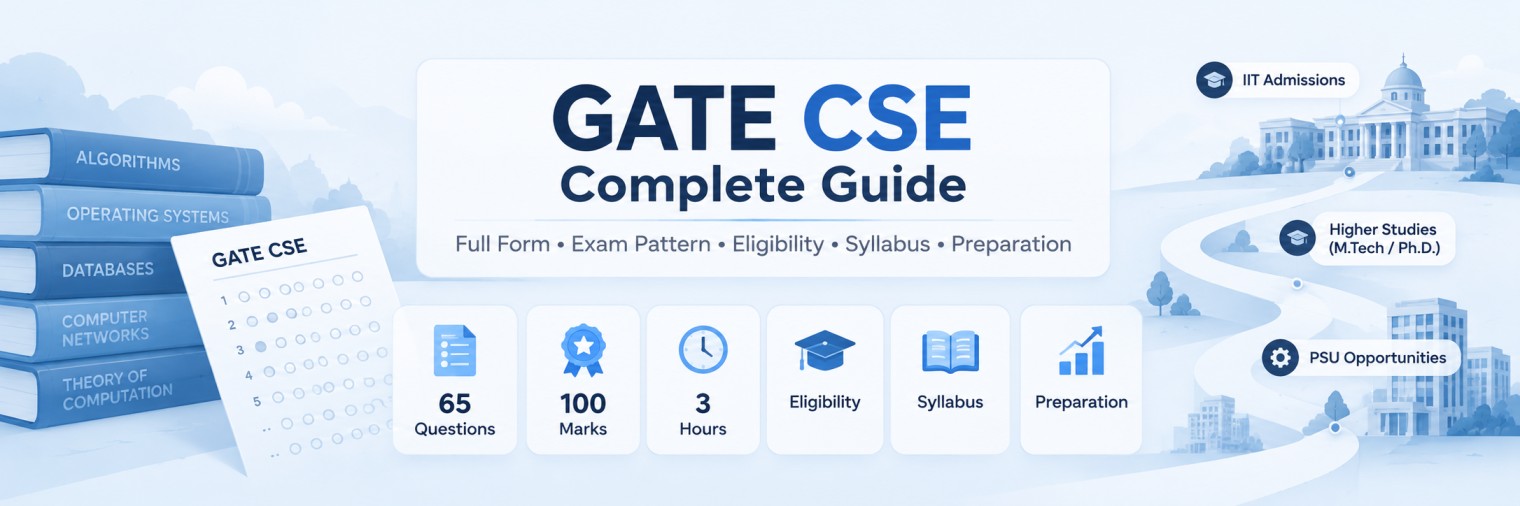
Key Takeaways
- GATE CSE full form: Graduate Aptitude Test in Engineering — Computer Science and Information Technology.
- The exam has 65 questions worth 100 marks, completed in 3 hours on a Computer-Based Test platform.
- Question types: MCQ (negative marking applies), MSQ, and NAT (no negative marking on either).
- GATE CS 2027 is organised by IIT Madras; exam dates are 6–7, 13–14, and 20–21 February 2027.
- Eligibility: 3rd-year and above students or graduates of an approved degree — no age limit, no restriction to CS/IT students only.
- 10 core sections: Engineering Mathematics, Digital Logic, COA, Programming and Data Structures, Algorithms, TOC, Compiler Design, OS, Databases, Computer Networks.
- Programming language tested: C (not Python, unlike GATE DA).
- A GATE CSE score opens doors to IIT/IISc M.Tech admissions, PSU technical recruitment, and central government research roles.
What Is GATE CSE? Full Form and Overview
GATE CSE is the Computer Science and Information Technology paper under the Graduate Aptitude Test in Engineering. While commonly called "GATE CSE" (Computer Science and Engineering) in student circles, the official paper code is CS and covers both computer science and information technology topics.
GATE itself — the Graduate Aptitude Test in Engineering — is conducted jointly by the IITs and IISc every year for admission to postgraduate programs and recruitment by PSUs. The CS paper has existed since GATE's earliest editions and has grown from a few thousand candidates to over 2.5 lakh in 2026, reflecting the explosive growth of computer science as a career path in India.
Unlike GATE DA (Data Science and AI), which focuses on mathematics, ML, and Python, GATE CSE covers the full depth of computer science — operating systems, computer architecture, theory of computation, compiler design, computer networks, databases, algorithms, and more. It tests both conceptual understanding and the ability to solve complex numerical problems under time pressure. See the official GATE 2027 website for the current exam calendar.
Who Should Read This GATE CSE Guide?
- Students deciding whether to appear for GATE CS or GATE DA
- Final-year and pre-final-year CS/IT/ECE students planning for GATE 2027 or 2028
- Working professionals considering a return to academics via IIT M.Tech
- Aspirants who want exam pattern, eligibility, syllabus, and career scope in one verified place
GATE CSE 2027 Exam Pattern
GATE CS 2027, organised by IIT Madras, follows the standard GATE format. Here is the complete, verified exam pattern:
| Parameter | Details |
|---|---|
| Total Marks | 100 |
| Total Questions | 65 |
| Duration | 3 hours |
| Question Types | MCQ (1 & 2 marks), MSQ, NAT |
| General Aptitude | 15 marks (10 questions) |
| Engineering Mathematics | 13 marks (fixed) |
| CS Core Subjects | 72 marks (remaining) |
| Exam Mode | Computer-Based Test (CBT), online |
| Programming Language | C |
| Organising Institute (2027) | IIT Madras |
| Exam Dates (2027) | 6–7, 13–14, 20–21 February 2027 |
Question Types Explained
- MCQ (Multiple Choice Questions): One correct answer out of four options. Negative marking applies — ⅓ for 1-mark questions, ⅔ for 2-mark questions.
- MSQ (Multiple Select Questions): One or more correct answers. All correct options must be selected for full marks — no partial credit. No negative marking.
- NAT (Numerical Answer Type): Calculate and type a numerical value. No options provided, no negative marking. NAT questions are your highest-value risk-free opportunities — attempt every one you can compute.
GATE CSE Negative Marking Rules
| Question Type | Marks | Negative Marking |
|---|---|---|
| 1-Mark MCQ | 1 | −⅓ mark for wrong answer |
| 2-Mark MCQ | 2 | −⅔ mark for wrong answer |
| MSQ (1 or 2 marks) | 1 or 2 | None |
| NAT (1 or 2 marks) | 1 or 2 | None |
Practical tip: For MCQs where you can eliminate two of four options, guessing has a positive expected value. For MCQs where you cannot eliminate any option, do not guess — the expected value is negative. NAT and MSQ questions carry no penalty, so always attempt them if you can calculate or reason toward an answer.
GATE CSE Eligibility Criteria
GATE CS eligibility is broader than many candidates assume. You do not need a Computer Science Engineering degree to appear for the CS paper.
Who Can Appear?
- Candidates with B.E./B.Tech in any engineering discipline — CS, IT, ECE, EE, Mechanical, and others
- Candidates with B.Sc. (Research/4-year), B.S., or integrated M.Sc./M.Tech in science or mathematics
- Students currently in their 3rd year or higher of an eligible undergraduate degree program
- No upper age limit for appearing in GATE
- Working professionals can appear — many candidates prepare successfully while employed full-time
Candidates should always verify the current-year official GATE notification for exact eligibility conditions, accepted degree types, and application rules. Check the official GATE 2027 FAQs from IIT Madras for authoritative guidance.
GATE CS 2027 registration opened on 2 September 2026. The regular deadline is 27 September 2026 and the extended deadline (with late fee) is 5 October 2026. Apply at gate2027.iitm.ac.in.
GATE CSE Syllabus Overview
The GATE CS paper has 10 subject sections. General Aptitude carries a fixed 15 marks; Engineering Mathematics carries a fixed 13 marks; the remaining 9 CS subject sections collectively account for 72 marks. Download the official GATE CS 2027 syllabus PDF from IIT Madras for the complete topic list.
| Section | Selected Topics |
|---|---|
| Engineering Mathematics | Discrete mathematics (graph theory, logic, combinatorics), linear algebra (eigenvalues), probability, calculus |
| Digital Logic | Boolean algebra, K-map minimisation (algebraic, tabular), combinational circuits, sequential circuits (flip-flops, counters) |
| Computer Organisation & Architecture | Machine instructions, pipelining, memory hierarchy, cache mapping, hardwired/microprogrammed control design, I/O |
| Programming and Data Structures | C programming, recursion, arrays, linked lists, stacks, queues, trees, binary heaps, hashing, graphs |
| Algorithms | Asymptotic analysis, searching/sorting, graph algorithms (BFS/DFS, shortest paths, MST), dynamic programming, NP-completeness |
| Theory of Computation | Regular languages (DFA/NFA, pumping lemma), context-free grammars, PDAs, Turing machines, decidability, P vs NP |
| Compiler Design | Lexical analysis, parsing (LL, LR), syntax-directed translation, intermediate code generation, data flow analysis |
| Operating Systems | Processes, CPU scheduling, memory management (paging, segmentation), page replacement, synchronisation, deadlock, file systems |
| Databases | ER/relational model, SQL, relational algebra, normalisation (1NF–BCNF), B+ trees, transactions, concurrency control |
| Computer Networks | Principles of layering, error detection, MAC (CSMA/CD), routing (DV/LS), IPv4/CIDR/NAT, TCP flow/congestion control, DNS, HTTP |
| General Aptitude | Verbal, quantitative, and analytical aptitude |
Three sections have revised syllabi for GATE CS 2027: Digital Logic (minimisation methods explicitly named), COA (control-unit design added; main/secondary storage removed), and Computer Networks (significantly reduced — OSI model naming, ARP, DHCP, SMTP, FTP removed). For detailed topic-by-topic coverage and previous year frequency analysis, read our GATE CSE 2027 important topics guide.
Subject-Wise Weightage: Not all sections contribute equally to your score. Engineering Mathematics (13 marks, fixed) and DSA/Algorithms (10–14 marks combined) are the highest-value preparation targets. For a detailed marks breakdown across all sections, see our GATE CSE subject-wise weightage analysis.
GATE CSE vs GATE DA: Which Should You Choose?
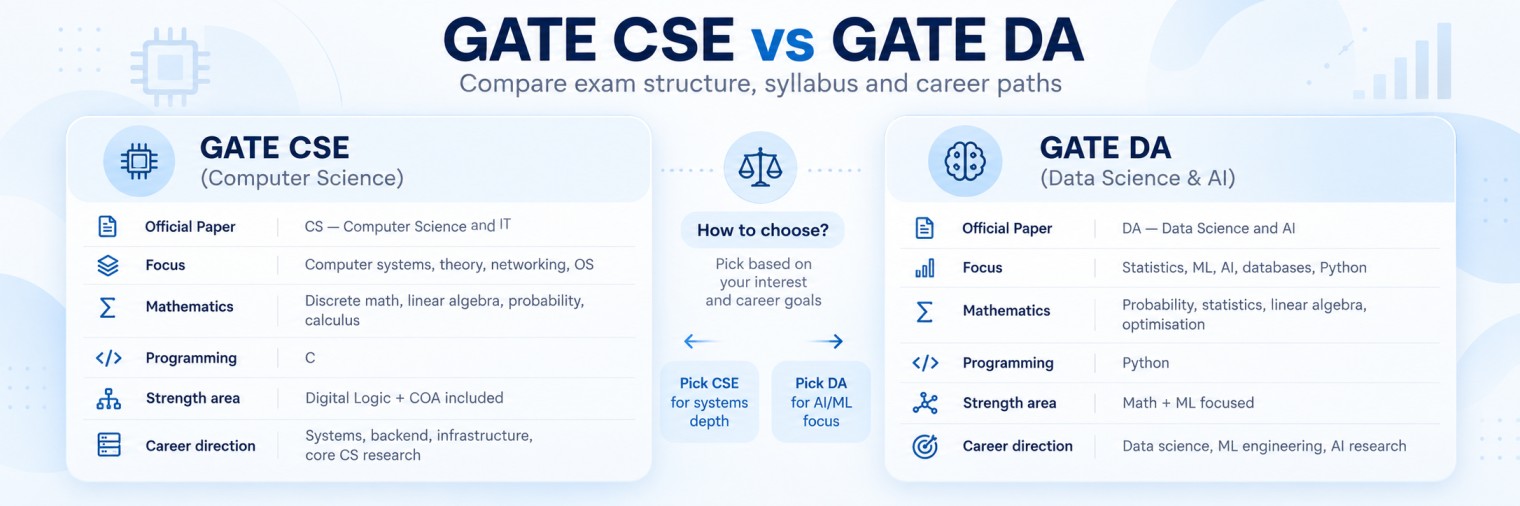
| Feature | GATE CSE (Computer Science) | GATE DA (Data Science & AI) |
|---|---|---|
| Official Paper | CS — Computer Science and IT | DA — Data Science and AI |
| Focus | Computer systems, theory, networking, OS | Statistics, ML, AI, databases, Python |
| Mathematics | Discrete math, linear algebra, probability, calculus | Probability, statistics, linear algebra, optimisation |
| Programming Language | C | Python |
| Hardware Topics | Digital logic, COA (included) | Not included |
| Syllabus Breadth | Broad — 10 sections including systems & theory | Focused — 7 sections, math and ML heavy |
| Candidate Volume (2026) | 2,59,922 registered (IIT Guwahati data) | Rapidly growing from smaller 2024–2025 base |
| Career Direction | Systems, backend, infrastructure, core CS research | Data science, ML engineering, AI research |
| PSU Acceptance | Very widely accepted across PSUs | Varies by PSU notification; check before applying |
Choose GATE CSE if you are interested in operating systems, compiler design, computer networks, systems programming, theoretical CS, or want the widest PSU acceptance. Choose GATE DA if your primary interest is machine learning, data science, or AI research. For a full data-backed comparison, read our GATE DA vs GATE CS analysis.
How to Prepare for GATE CSE
GATE CS preparation follows a well-established pattern that consistently produces high scores. Guided by faculty who are IIT Bombay alumni and GATE CS toppers (AIR 2 and AIR 90 in GATE CS), here is the proven phased approach:
Phase 1: Build Foundations (Months 1–2)
- Engineering Mathematics first: Graph theory, probability, and linear algebra appear in at least 4–5 questions per paper. This is the highest-certainty marks block.
- Digital Logic: K-map minimisation, flip-flops, combinational circuits — these are mechanical and learnable, best completed early before moving to more theory-heavy subjects.
- Start C programming: Basic C understanding is assumed across Programming and Data Structures, OS, and Compiler Design questions. Get comfortable with pointers, recursion, and time complexity analysis.
Phase 2: Core CS Subjects (Months 3–4)
- Algorithms and Data Structures: BFS/DFS, graph algorithms (Dijkstra, Bellman-Ford, Kruskal), dynamic programming, AVL trees, B-trees, hashing — these carry 10–14 marks combined.
- Theory of Computation + Compiler Design: Study these together — TOC provides the formal language theory that underpins Compiler Design parsing. DFA minimisation, pumping lemma, FIRST/FOLLOW sets, LL(1)/LR parsing.
- COA: Pipeline timing diagrams, cache mapping calculations, control unit design (hardwired and microprogrammed — new for 2027).
Phase 3: OS, DBMS, and Networks (Month 5)
- Operating Systems: CPU scheduling numericals, page replacement algorithms (LRU, FIFO, Optimal), Banker's algorithm, inode file system calculations. OS is numerically intensive — solve 20+ problem sets per algorithm type.
- DBMS: SQL query tracing, normalisation up to BCNF, B+ tree operations, concurrency control (serializability).
- Computer Networks (2027 reduced syllabus): Focus only on retained topics — distance-vector/link-state routing, IPv4/CIDR, TCP slow start and AIMD, sliding window throughput, CRC, DNS, HTTP. Do not prepare removed topics.
Phase 4: Revision and Mock Tests (Month 5–6)
Take full-length timed mock tests from January onwards. Analyse every wrong answer by category — conceptual gap, application error, or time pressure. Practise PYQs on SuccessTracker for structured previous-year question practice with performance tracking. For a complete month-by-month schedule, see our GATE CSE 2027 study plan.
Why Mock Tests Matter for GATE CSE
GATE CS cannot be cracked by reading alone. Mock tests serve two irreplaceable purposes:
- Exam stamina: Solving 65 technical questions over 3 hours under time pressure is a skill you must train. Candidates who sit their first full-length mock a week before the exam consistently score 10–15 marks below their practice performance.
- Weak area identification: Mock tests reveal whether your problem is conceptual (wrong understanding), computational (calculation errors), or strategic (wrong time allocation).
The ML Hub's GATE CS Course includes subject-wise tests, multi-subject mocks, and full-length mock exams modelled on the GATE CS paper pattern, built by IIT Bombay alumni who have appeared in and topped GATE CS.
Career Paths After GATE CSE
M.Tech and M.S. Admissions at IITs and NITs
GATE CS scores are accepted by all IITs, IISc, and NITs for M.Tech in Computer Science, Information Technology, AI, Data Science, and related specialisations. IIT Bombay, Delhi, and Madras typically require a GATE score above 800 (roughly 75+ marks) for General category candidates to enter the interview pool. Top NITs admit candidates with scores in the 580–700 range. For a full score-to-admission mapping, read the GATE CSE cutoff analysis and the GATE CSE marks vs rank guide.
Ph.D. Programs
A high GATE CS score supports applications to Ph.D. programs at IITs and IISc in areas including algorithms, systems, AI, security, and distributed computing. GATE CS is the primary entry criterion for most research program admissions at these institutions.
PSU Recruitment
GATE CS scores are among the most widely accepted by Public Sector Undertakings for technical recruitment. PSUs like BHEL, ISRO, DRDO, BARC, ONGC, and NTPC have used GATE CS scores in recruitment cycles. Specific score requirements and paper acceptance vary by notification — always verify against the individual PSU advertisement.
Central Government Research and Defence
Organisations like DRDO, C-DAC, and various defence R&D units recruit technical staff using GATE scores. GATE CS is particularly relevant for roles in embedded systems, cryptography, and software engineering at these organisations.
GATE CSE for Beginners: Where to Start
- Understand the paper: Read this guide and the GATE CSE syllabus 2027 breakdown to know exactly what is tested.
- Assess your C programming level: If you have never written a recursive function in C or traced through a pointer-based linked list, that is your starting point.
- Pick one book per subject: CLRS for Algorithms, Sipser for TOC, Silberschatz-Galvin for OS, Silberschatz-Korth for DBMS, Morris Mano for Digital Logic. These are the standard references the paper is written against.
- Start PYQ practice early: Solve topic-specific GATE previous year questions from the moment you finish each chapter — not at the end of the syllabus. Use SuccessTracker for organised PYQ practice.
- Set a target score before studying: Use the marks vs rank table to reverse-engineer what raw marks you need for your goal institute, then plan backwards.
Prepare for GATE CSE 2028 with ML HUB
The ML Hub's GATE CS Course is built by Jay Bansal (AIR 2, GATE CS 2019) and Sriniwas Paliwal (AIR 90, GATE CS 2019), both IIT Bombay alumni. The course covers all 10 GATE CS subjects with:
- Recorded lectures covering the complete GATE CS 2027/2028 syllabus
- Subject-wise mock tests aligned with GATE paper patterns
- Annotated PYQ solutions for all GATE CS papers from 2018–2026
- Doubt resolution from GATE CS toppers
- Performance analytics to track your subject-wise readiness
Explore the GATE CS Course | Visit themlhub.ai/gate-cs-course
Frequently Asked Questions
What is the full form of GATE CSE?
GATE CSE stands for Graduate Aptitude Test in Engineering — Computer Science and Information Technology. The official paper code used by GATE is "CS" (Computer Science and Information Technology). It is colloquially referred to as GATE CSE (Computer Science and Engineering) in student communities, though the full official name includes Information Technology.
What is the GATE CSE exam pattern for 2027?
GATE CS 2027 has 65 questions worth 100 marks, completed in 3 hours. General Aptitude carries 15 marks (10 questions); Engineering Mathematics carries 13 marks; the remaining 9 CS sections carry 72 marks combined. Question types include MCQs (with negative marking), MSQs, and NATs (no negative marking on either). The exam is a Computer-Based Test conducted by IIT Madras in February 2027.
Does GATE CSE have negative marking?
Yes, but only for MCQs. A wrong answer on a 1-mark MCQ deducts ⅓ mark; a wrong answer on a 2-mark MCQ deducts ⅔ mark. MSQ and NAT questions carry no negative marking — always attempt these if you can reason toward an answer.
Who is eligible for GATE CSE 2027?
Candidates in the 3rd year or above of an eligible undergraduate degree (B.E./B.Tech, B.Sc., B.S., or integrated M.Sc./M.Tech in any engineering or science discipline) are eligible to appear for GATE CS. There is no age limit and no requirement to have a CS/IT specific background. Verify exact eligibility conditions in the official GATE 2027 notification from IIT Madras at gate2027.iitm.ac.in.
What is a good GATE CSE score for IIT admission?
A GATE score above 800 (roughly 75+ marks) puts you in the interview pool for most IITs. For IIT Bombay, Delhi, and Madras, scores above 820 with ranks below 200 are typically needed for M.Tech CSE. For top NITs, a GATE score in the 580–700 range (roughly 55–68 marks) is competitive. See the GATE CSE cutoff guide for institute-wise thresholds.
What is the GATE CSE qualifying cutoff?
The GATE CSE qualifying cutoff for General/EWS category was 30.0 marks out of 100 in 2026 (IIT Guwahati), 29.2 in 2025 (IIT Roorkee), and 27.6 in 2024 (IISc Bangalore). OBC-NCL candidates qualify at 90% of the General cutoff; SC/ST/PwD candidates qualify at two-thirds. Qualifying only makes your scorecard valid — IIT admissions require scores significantly above the qualifying cutoff.
Is GATE CSE harder than GATE DA?
GATE CS has a broader syllabus (10 sections vs 7 for DA), includes systems and hardware topics that require specific CS background, and has a significantly larger candidate pool (over 2.5 lakh in 2026 vs DA's much smaller pool). GATE DA is more mathematically intensive with ML theory depth. Neither is objectively harder — the right choice depends on your background and career goals.
How many candidates appeared in GATE CSE 2026?
In GATE CS 2026, organised by IIT Guwahati, 2,59,922 candidates registered and 2,11,020 appeared. This represents a significant year-on-year increase from 2,07,851 registered in 2025 and 1,52,652 in 2024, reflecting growing competition for IIT and NIT admissions.
What career options are available after GATE CSE?
A strong GATE CS score supports: M.Tech/M.S./Ph.D. admissions at IITs, IISc, and NITs; PSU technical recruitment (BHEL, ISRO, DRDO, BARC, ONGC); central government research roles (C-DAC, DRDO labs); and teaching assistant positions at IITs. GATE CS is also increasingly used by private sector companies (particularly in R&D roles) as a proxy for core computer science knowledge, though direct PSU hiring is its primary institutional use.
Conclusion
GATE CSE is the most competitive and widely used computer science entrance examination in India, opening doors to IIT/IISc postgraduate admissions, PSU recruitment, and research positions. Whether you are a final-year CS student targeting IIT Bombay M.Tech or a working professional planning a career transition into advanced computer science, the path begins with understanding what GATE CS actually tests — and preparing accordingly.
The key is structured preparation: anchor your study plan on the highest-weightage subjects (Engineering Mathematics, DSA, TOC), build numerical problem-solving depth through consistent practice, and run full-length mock tests before the exam. For a detailed subject-wise preparation breakdown, read the GATE CSE 2027 preparation strategy guide. To understand how your marks convert to a score and rank, see GATE CSE marks vs rank. To start with a proven course, explore the ML HUB GATE CS Course built by GATE CS toppers from IIT Bombay.