Here's a fact worth bookmarking: the U.S. Bureau of Labor Statistics projects data scientist roles to grow by approximately 35% between 2023 and 2033, well above the average for all occupations (BLS, 2024). If you're a GATE DA or GATE CS aspirant wondering whether a Data Science Career is worth the investment, the answer is yes — but only if you build the right skills and follow a structured path. This guide covers the 2026 job market, salary benchmarks, skill requirements, and how GATE DA opens doors that a standard engineering degree alone cannot.
Data Science Career: a professional path centred on using statistics, programming, and domain knowledge to extract actionable insights from large datasets — spanning roles from Data Analyst and Data Scientist to ML Engineer and AI Research Scientist.
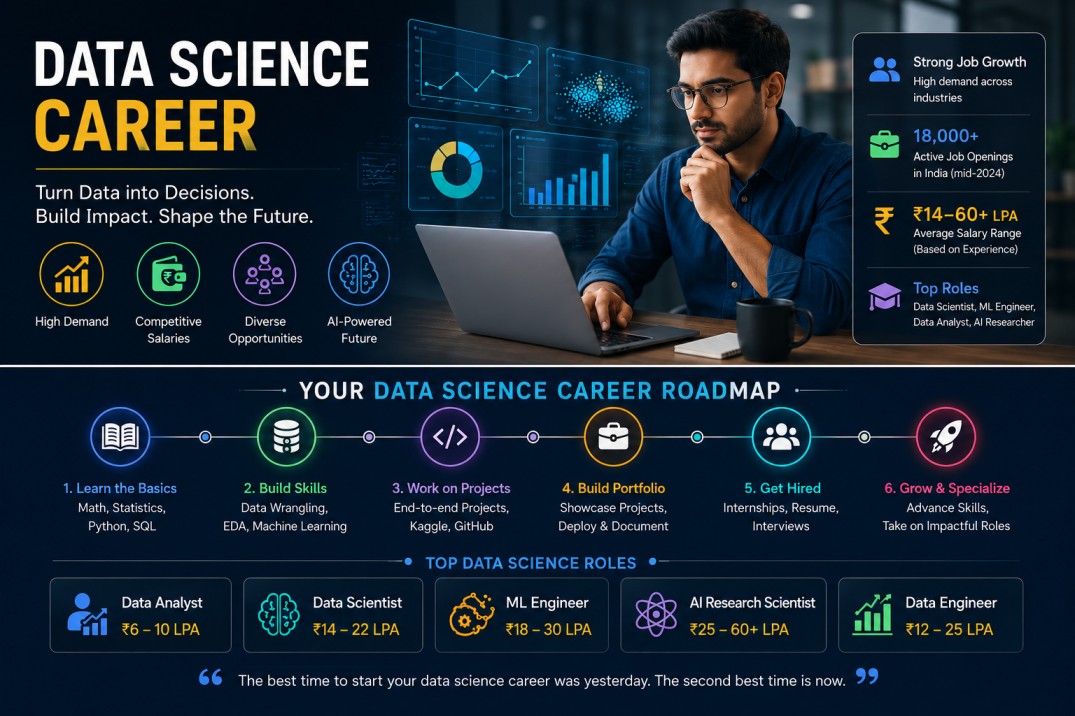
Quick Summary
- Who this is for: GATE DA and GATE CS aspirants, engineering graduates, and working professionals targeting data science roles in India and globally
- Job market: Strong and growing demand in India and globally; BLS projects approximately 35% growth for data scientists in the US through 2033 (BLS, 2024)
- Must-have skills: Python (Pandas, NumPy, Scikit-learn), SQL, machine learning algorithms, statistics, and linear algebra
- Salary range (India): INR 6–10 LPA entry-level to INR 40–70+ LPA at lead and research levels
- GATE DA advantage: Supports M.Tech admissions at select IITs, NITs, and IIITs (accepted papers and eligibility vary by institute); signals verified mathematical competence to employers; PSU eligibility depends on the organisation and its recruitment notification
- Career progression: Data Analyst → Data Scientist → Senior Data Scientist → Lead/Principal Data Scientist (5–8 years typically)
What Does the Data Science Job Market Look Like in 2026?
The data science job market in 2026 is large, competitive, and increasingly specialised. Generalist roles face more competition while demand for specialised functions — ML engineering, data engineering, NLP, and analytics — continues to grow. Knowing which specialisation aligns with your skills is the first step toward a focused Data Science Career strategy.
Data science vacancies in India span roles from entry-level data analysts to senior ML researchers, with job boards consistently listing large volumes of open positions across hiring cycles. Demand has remained strong. According to the World Economic Forum's Future of Jobs Report 2025, Big Data Specialists and AI & Machine Learning Specialists are among the fastest-growing roles globally by 2030 (WEF, 2025).
The market splits into three clear tiers:
- Tier 1 (High demand, high pay): ML Engineer, Data Engineer, AI Research Scientist
- Tier 2 (High demand, moderate pay): Data Analyst, Business Intelligence Analyst
- Tier 3 (Specialised, niche pay): Data Architect, NLP Engineer, Computer Vision Engineer
Each tier requires a different skill combination. Most job seekers make the mistake of targeting Tier 1 roles with only Tier 2 skills. That mismatch accounts for a significant portion of rejected applications. Fix the mismatch first, then apply.
How Do You Start a Data Science Career From Scratch?
Starting a Data Science Career requires a deliberate sequence of steps, not random course completion. A structured path combines mathematical foundations, programming skills, real project experience, and a credentialling milestone like GATE DA that signals verified competence to employers.
Here's a step-by-step process that works in 2026:
- Build mathematical foundations first. Linear algebra, probability, and calculus are not optional. They underpin every ML algorithm. Without them, you're copying code without understanding it.
- Learn Python with a data science focus. Pandas, NumPy, Scikit-learn, and Matplotlib are your core toolkit. Add SQL for data extraction and cleaning.
- Study machine learning concepts. Start with supervised learning (regression, classification), then unsupervised methods (clustering, dimensionality reduction). Understand the math behind each model, not just the API.
- Work on real datasets. Kaggle competitions and open government datasets are excellent starting points. Two completed, documented projects tend to carry more weight with recruiters than ten half-finished ones.
- Prepare for and clear GATE DA or GATE CS. GATE DA supports admission to M.Tech programs in data science and AI at select IITs, NITs, and IIITs — accepted papers and eligibility criteria vary by institute. It also adds credibility for certain PSU recruitment processes, depending on the organisation's notification.
- Build a portfolio on GitHub. Recruiters check repositories. A clean, documented project matters more than a certificate from a random MOOC.
- Apply for internships or entry-level roles. Don't wait until you feel ready. Apply when you have two solid projects and can explain your thought process clearly in an interview.
Also Read: Python and DSA for GATE DA: A Complete Preparation Guide
What Skills Are Non-Negotiable for a Data Science Career?
The skills that define a successful Data Science Career in 2026 fall into three categories: technical depth, mathematical reasoning, and communication. Employers now screen harder for depth than breadth. Knowing five tools well beats knowing twenty tools superficially.
Technical Skills You Must Have
| Skill | Why It Matters | Proficiency Level Needed |
|---|---|---|
| Python (Pandas, NumPy, Scikit-learn) | Core language for data manipulation and modelling | Advanced |
| SQL | Data extraction from relational databases | Intermediate to Advanced |
| Machine Learning algorithms | Building and evaluating predictive models | Advanced |
| Statistics and Probability | Model evaluation, hypothesis testing, inference | Advanced |
| Data Visualisation (Matplotlib, Tableau) | Communicating findings to non-technical stakeholders | Intermediate |
| Deep Learning (TensorFlow, PyTorch) | Neural networks, NLP, computer vision applications | Intermediate (essential for senior roles) |
Mathematical Foundations That Separate Candidates
Linear algebra supports dimensionality reduction techniques like PCA. Probability theory feeds directly into Bayesian models and statistical inference. Calculus is essential for understanding gradient descent, the optimisation engine behind most modern ML models.
GATE DA directly tests all three areas. Clearing the exam signals to recruiters that your mathematical fundamentals are solid — a concrete, verifiable signal rather than a self-reported claim on a resume.
Also Read: Linear Algebra for GATE DA: Concepts, Questions, and Resources
Also Read: Probability and Statistics for GATE DA: Complete Coverage
Soft skills matter too. Storytelling with data, structured problem-framing, and cross-functional communication consistently appear in senior data science job descriptions. If you can't explain a model's output to a non-technical product manager, you're capped at mid-level regardless of technical depth.
Data Scientist Salary Trends in 2026
Data scientist salaries vary significantly by role, company, location, specialisation, and experience. In India, approximate entry-level ranges start around INR 6–8 LPA, while senior and lead roles can reach INR 25–40 LPA or higher. In the United States, the Bureau of Labor Statistics tracks the median annual wage for data scientists — see the BLS OOH page for the most current figure.
The salary spread is wide because the title "data scientist" covers a large range of responsibilities. Here's how compensation breaks down by role type in the Indian market:
| Role | Entry-Level (INR LPA) | Mid-Level (INR LPA) | Senior Level (INR LPA) |
|---|---|---|---|
| Data Analyst | 4–6 | 8–14 | 16–22 |
| Data Scientist | 6–10 | 14–22 | 25–40 |
| ML Engineer | 8–12 | 18–28 | 32–55 |
| Data Engineer | 7–11 | 16–24 | 28–45 |
| AI Research Scientist | 10–15 | 22–35 | 40–70+ |

Candidates who clear GATE DA and join an M.Tech program may see salary benefits that depend on the institute, role, prior experience, and market conditions at the time of placement. An M.Tech credential from a premier institute can be a meaningful signal to employers, though actual outcomes vary by individual circumstance.
GATE DA Career Opportunities: How the Exam Strengthens Your Data Science Career
GATE DA supports M.Tech admissions at select IITs, NITs, and IIITs (accepted papers and eligibility vary by institute), adds credibility for certain PSU recruitment processes (eligibility depends on the organisation's notification), and provides a nationally recognised credential signalling verified technical competence. For engineering graduates targeting a Data Science Career in India, GATE DA is one of the most structured preparation pathways available.
GATE DA: Graduate Aptitude Test in Engineering — Data Analytics, a national exam testing data analytics, machine learning, probability, statistics, Python, and database management.
The career paths that open after GATE DA include:
- M.Tech in Data Science or Artificial Intelligence at IITs, NITs, and IIITs
- Research positions in institutions funded by DST, DRDO, and ISRO
- PSU recruitment processes where GATE scores are a factor — eligibility and weighting depend on the specific organisation and its recruitment notification
- Faster entry into product companies that recognise IIT M.Tech credentials
Preparing for GATE DA means mastering machine learning theory, DBMS, Python programming, statistics, and linear algebra — topics that map closely to what employers assess in data science technical interviews. There is significant overlap between GATE DA exam preparation and the skills needed for a data science career, making structured exam study a productive dual investment.
Also Read: Machine Learning for GATE DA: Complete Topic Guide
Also Read: GATE DA Complete Guide 2027: Syllabus, Pattern, and Preparation
Data Science Career Path Progression: From Analyst to Lead
A Data Science Career typically moves through four stages: Data Analyst, Data Scientist, Senior Data Scientist, and Lead or Principal Data Scientist. Each stage demands deeper technical expertise and broader business impact. The timeline from entry to lead is typically five to eight years for focused professionals.
Here's what each stage looks like in practice:
Stage 1: Data Analyst (Year 0–2) You focus on SQL, dashboarding, and basic statistical analysis. You answer business questions with existing data. Salary range: INR 4–8 LPA.
Stage 2: Data Scientist (Year 2–4) You build predictive models, run A/B tests, and work on feature engineering. You start owning a problem end-to-end. Salary range: INR 10–22 LPA.
Stage 3: Senior Data Scientist (Year 4–6) You lead projects, mentor junior scientists, and connect technical decisions to business outcomes. Salary range: INR 22–38 LPA.
Stage 4: Lead or Principal Data Scientist (Year 6+) You define data strategy for a product line or business unit. You hire, set technical direction, and present to senior leadership. Salary range: INR 38–70+ LPA.
The fastest way to accelerate through Stage 1 is not to take more courses — it's to deliver one high-impact project that gets used by real stakeholders. That project becomes your story in every interview for the next three years.
Entry-Level Data Science Jobs: What Recruiters Actually Look For
Entry-level data science jobs in 2026 require Python proficiency, SQL skills, at least one end-to-end project, and a basic understanding of ML concepts. A degree or GATE score provides the credential. Real projects and a documented GitHub portfolio prove the skill.
Most job descriptions for junior data scientists list 10–15 requirements. Three of them actually determine whether you get an interview:
- Can you write clean Python code for data manipulation and model building?
- Do you have a project where you went from raw data to a deployed or clearly presented insight?
- Can you explain the difference between overfitting and underfitting, and how you addressed it in your project?
The rest of the job description is a wish list. Focus on the three above first, and you'll pass the initial screening filter at most companies.
Common entry-level roles to target:
- Junior Data Analyst
- Data Science Intern (with conversion to full-time)
- Business Intelligence Analyst
- Associate Data Scientist
- Junior ML Engineer
Also Read: Best Online Courses for GATE DA: Verified Resources and Recommendations
What Is the Future of Data Science Jobs?
The future of data science jobs points toward AI-augmented workflows, tighter specialisation, and a premium on engineers who can build production systems rather than just Jupyter notebooks. Pure exploratory analysis roles will consolidate. Engineers who can deploy, monitor, and retrain models will command significantly higher pay.
According to the WEF Future of Jobs Report 2025, AI and data specialist roles will see the largest absolute increase in demand of any job category through 2030 (WEF, 2025). The National Careers Service in the UK notes that the typical route into data scientist roles now includes postgraduate study or specialist certification, reflecting how the entry bar has risen (National Careers Service, 2024).
Three specific trends are reshaping the field right now:
- MLOps and deployment skills are now table stakes. Knowing how to train a model is not enough. You need to containerise it, monitor it in production, and retrain it at scale. Tools like MLflow, Docker, and Kubernetes appear in junior job descriptions.
- Domain specialisation can improve compensation prospects. A data scientist with deep healthcare, fintech, or manufacturing knowledge tends to be more competitive than a generalist with otherwise identical technical skills. Pick a domain early and build that context deliberately.
- AI tools are not replacing data scientists. They are replacing data scientists who refuse to use AI tools. Learning to use LLMs for code generation, documentation, and exploratory data analysis accelerates output without replacing the judgement that makes a data scientist valuable.
The contrarian truth about 2026 is this: the data science job market is harder to enter at the bottom and more lucrative at the top than it was three years ago. The gap between candidates who prepared properly and those who didn't has never been wider.
Key Takeaways
- Data science demand in India and globally remains strong. The WEF Future of Jobs Report 2025 lists Big Data Specialists and AI & Machine Learning Specialists among the fastest-growing roles by 2030.
- A successful Data Science Career requires Python, SQL, machine learning, statistics, and linear algebra. Technical depth beats breadth in 2026 hiring.
- GATE DA is one of the most structured pathways for Indian engineering graduates targeting M.Tech programs in data science and AI at select institutes, while building skills that closely align with what employers assess in technical interviews. Accepted GATE papers and PSU eligibility depend on the specific institute or organisation.
- Salaries vary by role, company, location, and experience. Approximate ranges start around INR 6–10 LPA at entry level and can reach INR 40+ LPA at senior and lead levels. ML Engineers and AI Research Scientists often command higher compensation than generalist analysts, though actual packages depend on individual circumstances.
- Entry-level roles prioritise real, documented projects and GitHub portfolios over certifications and completed MOOCs.
- The future of data science jobs favours specialists with MLOps skills, domain expertise, and the ability to deploy and maintain production-grade systems.
- GATE DA preparation and data science career preparation have significant overlap. The exam syllabus covers machine learning, probability, statistics, linear algebra, and programming — topics closely aligned with what employers assess in technical interviews.
Start Your Data Science Career With the Right Foundation
A strong Data Science Career doesn't start with the perfect job offer — it starts with the right preparation. ML HUB's GATE DA course covers every topic on the exam syllabus, including machine learning, probability, statistics, linear algebra, Python, and DBMS, with structured practice tests and expert guidance built specifically for serious aspirants.
Explore the GATE DA 2027 Course | View the Test Series | View the Study Schedule | Try the Free Demo
FAQs
Is a Data Science Career a good choice in 2026?
Data science remains one of the stronger career choices in 2026. The U.S. Bureau of Labor Statistics projects approximately 35% job growth for data scientists through 2033. Demand across India and globally is strong, though the market increasingly rewards specialisation. Competition has grown compared to a few years ago, making focused skill-building more important than ever.
What qualifications do I need to start a Data Science Career?
A bachelor's degree in engineering, mathematics, statistics, or computer science is the standard baseline. Strong Python and SQL skills, working knowledge of ML algorithms, and at least two completed end-to-end projects are practical requirements. A GATE DA score adds significant credibility for Indian candidates targeting top firms, M.Tech programs, and public sector units.
How does GATE DA help in building a data science career?
GATE DA tests machine learning, probability, statistics, linear algebra, Python, and DBMS — topics closely aligned with what data science technical interviews assess. Clearing GATE DA can support M.Tech admissions at select IITs, NITs, and IIITs (accepted papers vary by institute), adds credibility for certain PSU recruitment processes (eligibility depends on the organisation's notification), and signals verified mathematical and technical competence to employers.
What is the average data scientist salary in India in 2026?
Data scientist salaries in India vary by role, company, location, and experience. Approximate ranges: entry-level positions around INR 6–10 LPA; mid-level roles around INR 14–22 LPA; senior and lead positions can reach INR 30+ LPA. ML Engineers and AI Research Scientists often command higher compensation than generalist data scientists, though actual packages depend on individual circumstances, company, and market conditions.
What programming languages are essential for a data science career?
Python is the primary language for data science in 2026. SQL is mandatory for data extraction and manipulation across every data role. R is useful for statistical analysis in specific industries like biostatistics and finance. Familiarity with Spark or Scala helps for big data engineering roles. Python, used well, handles the vast majority of data science work at most companies.
What is the difference between a Data Analyst and a Data Scientist?
A data analyst interprets existing data to answer defined business questions using SQL, Excel, and dashboards. A data scientist builds predictive models, runs experiments, and discovers patterns from unstructured or large-scale data using ML and statistical modelling. Data scientists typically require deeper programming and mathematics skills and tend to command higher salaries than data analysts at comparable experience levels, though the gap varies by company, location, and specialisation.
How long does it take to transition into a data science career?
With focused preparation, most engineering graduates can land an entry-level data science role within 12 to 18 months. The timeline shortens for candidates with strong mathematics backgrounds or those preparing for GATE DA, because exam preparation directly trains the skills employers test. Candidates with two solid portfolio projects and a clear narrative typically move faster than those with more certificates but no real projects.