GATE DA stands for Graduate Aptitude Test in Engineering — Data Science and Artificial Intelligence. It is a national-level exam conducted once a year by one of the IITs or IISc, designed specifically for candidates who want to pursue advanced study or careers in data science, machine learning, and AI.
Since its introduction in 2024, GATE DA has quickly become one of the most watched papers among students interested in data science, machine learning and AI. Unlike the broader GATE CS paper, GATE DA focuses entirely on the mathematical and algorithmic foundations of modern AI: probability, statistics, linear algebra, machine learning, and Python programming.
This guide covers everything you need to know about the GATE DA exam — the full form, exam pattern, eligibility criteria, syllabus overview, negative marking rules, preparation strategy, mock tests, career paths, and how The ML Hub can help you prepare effectively.
Key Takeaways
- GATE DA full form: Graduate Aptitude Test in Engineering — Data Science and Artificial Intelligence.
- The exam has 65 questions worth 100 marks, to be solved in 3 hours.
- Question types: MCQ, MSQ (Multiple Select), and NAT (Numerical Answer Type).
- Negative marking applies only to MCQs (⅓ for 1-mark, ⅔ for 2-mark questions).
- Eligibility is broad: third-year or higher students and graduates from approved degree programs can apply, subject to the latest official GATE eligibility rules.
- Core subjects: Probability & Statistics, Linear Algebra, Calculus, Programming (Python), DSA, ML, AI, and DBMS.
- A GATE DA score can support applications to relevant M.Tech, M.S. and research programs where the DA paper is accepted.
What Is GATE DA? Full Form and Overview
GATE DA is a specialized paper under the GATE exam that tests your knowledge of Data Science and Artificial Intelligence. The full form of DA in GATE is Data Science and Artificial Intelligence.
GATE itself — the Graduate Aptitude Test in Engineering — is conducted jointly by IITs and IISc for admission to postgraduate programs (M.Tech, M.S., Ph.D.) and recruitment by Public Sector Undertakings (PSUs). The DA paper was introduced because the existing CS paper did not adequately test the specific mathematical and ML skills needed for data science roles and research.
Unlike GATE CS, which covers operating systems, compilers, computer networks, and hardware topics, GATE DA is focused entirely on:
- Mathematics — probability, statistics, linear algebra, calculus, and optimization
- Programming — Python (not C, unlike GATE CS)
- Machine Learning and Artificial Intelligence
- Database Management and Warehousing
This focused scope makes GATE DA attractive for students from any engineering or science background who want to transition into AI and data science — not just those with a CS degree. For more details, see the official GATE overview.
Who Should Read This GATE DA Guide?
- Students deciding between GATE DA and GATE CS
- Non-CS students considering data science and AI
- Working professionals planning a switch into ML or analytics
- Aspirants looking for exam pattern, eligibility, syllabus and preparation direction in one place
GATE DA Exam Pattern
The GATE DA paper follows the standard GATE format with a specific focus on data science and AI topics. Here is the complete exam pattern:
| Parameter | Details |
|---|---|
| Total Marks | 100 |
| Total Questions | 65 |
| Duration | 3 hours |
| Question Types | MCQ (1 & 2 marks), MSQ, NAT |
| General Aptitude | 15 marks (10 questions) |
| Core Subjects | 85 marks (55 questions) |
| Exam Mode | Computer-Based Test (CBT), online |
| Conducted By | One of the IITs or IISc (rotates each year) |
| Frequency | Once a year, usually in February |
Question Types Explained
- MCQ (Multiple Choice Questions): One correct answer out of four options. These carry negative marking.
- MSQ (Multiple Select Questions): One or more correct answers. You must select all correct options to receive marks — no partial credit. No negative marking.
- NAT (Numerical Answer Type): You calculate and type a numerical value. No options are given. No negative marking.
MSQ and NAT questions tend to be harder because you cannot guess or eliminate options. However, they reward accuracy without risk — making them strategically important.
GATE DA Negative Marking Rules
Negative marking in GATE DA applies only to MCQs. Here is the exact breakdown:
| Question Type | Marks | Negative Marking |
|---|---|---|
| 1-Mark MCQ | 1 | −⅓ mark for wrong answer |
| 2-Mark MCQ | 2 | −⅔ mark for wrong answer |
| MSQ (1 or 2 Marks) | 1 or 2 | None |
| NAT (1 or 2 Marks) | 1 or 2 | None |
Practical tip: Attempt solvable MSQ and NAT questions without fear of negative marking, but do not waste excessive time on questions you cannot calculate confidently. For MCQs, only guess if you can confidently eliminate at least two options. A single wrong guess on a 2-mark MCQ costs you ⅔ of a mark, which can shift your rank by hundreds.
GATE DA Eligibility Criteria
GATE DA eligibility is broader than many candidates assume. You do not need a Computer Science degree to appear for this paper.
Who Can Appear?
- Candidates with a B.E./B.Tech in any engineering discipline (CS, ECE, EE, Mechanical, Civil, etc.)
- Candidates with a B.Sc. (Research/4-year), B.S., or integrated M.Sc./M.Tech in science or mathematics
- Students currently in their 3rd year or higher of an eligible degree program
- There is no upper age limit for appearing in GATE
- Working professionals can also appear — many aspirants prepare while working full-time
This broad eligibility means that students from Mechanical, Electrical, Civil, and other branches can pivot into data science and AI through GATE DA — provided they build the required mathematical and programming skills.
Candidates should verify the latest official GATE notification for current-year eligibility, accepted degree types, documents, and application rules. You can also check the official GATE 2027 FAQs for detailed guidance.
GATE 2027 is organized by IIT Madras. Registration through GOAPS opens on 2 September 2026 and closes on 27 September 2026 (without late fee) or 5 October 2026 (with late fee). Exams are scheduled for 6–21 February 2027. For the full timeline, see our GATE 2027 official website and dates guide. For a detailed breakdown of degree rules, age limit, attempts, documents and paper-selection rules, read our GATE exam eligibility 2027 guide.
GATE DA Syllabus Overview
The GATE DA syllabus covers seven core technical areas plus General Aptitude. The official marks split is 15 marks for GA and 85 marks for the seven DA subjects combined, for 100 marks total. No fixed subject-wise marks are published.
| Subject | Selected Topics |
|---|---|
| Programming & DSA | Python, stacks, queues, linked lists, trees, hash tables, searching, basic sorting, mergesort/quicksort, graph traversals and shortest paths |
| Probability & Statistics | Probability, conditional expectation and variance, random variables and distributions, CLT, confidence intervals, z/t/chi-squared tests |
| Machine Learning | Regression/classification, ridge regression, LDA, neural networks, leave-one-out/k-fold validation, k-means/k-medoid, hierarchical clustering and PCA |
| Artificial Intelligence | Informed/uninformed/adversarial search, propositional/predicate logic, conditional independence, variable elimination and sampling-based inference |
| Linear Algebra | Vector spaces, matrix properties, quadratic forms, Gaussian elimination, eigenvalues, determinant/rank/nullity, projections, LU and SVD |
| Calculus & Optimization | Single-variable functions, limits, continuity, differentiability, Taylor series, maxima/minima and single-variable optimization |
| DBMS & Warehousing | ER/relational models, relational algebra, tuple calculus, SQL, constraints, normal forms, file organization, indexing, data types and transformation, multidimensional schemas, concept hierarchies and measures |
| General Aptitude | Verbal, quantitative, analytical and spatial aptitude |
Download the official GATE DA 2027 syllabus for the complete topic list.
Preparation guidance: Mathematics supports ML and AI, while regular Python practice develops algorithmic fluency. Use these prerequisites and your diagnostic results to plan study time, not assumed marks shares.
Detailed Syllabus: For the complete topic-by-topic breakdown and prerequisite-based guidance, read our GATE DA Syllabus 2027: Official Topics & Prep Plan.
GATE DA vs GATE CS: Which Should You Choose?
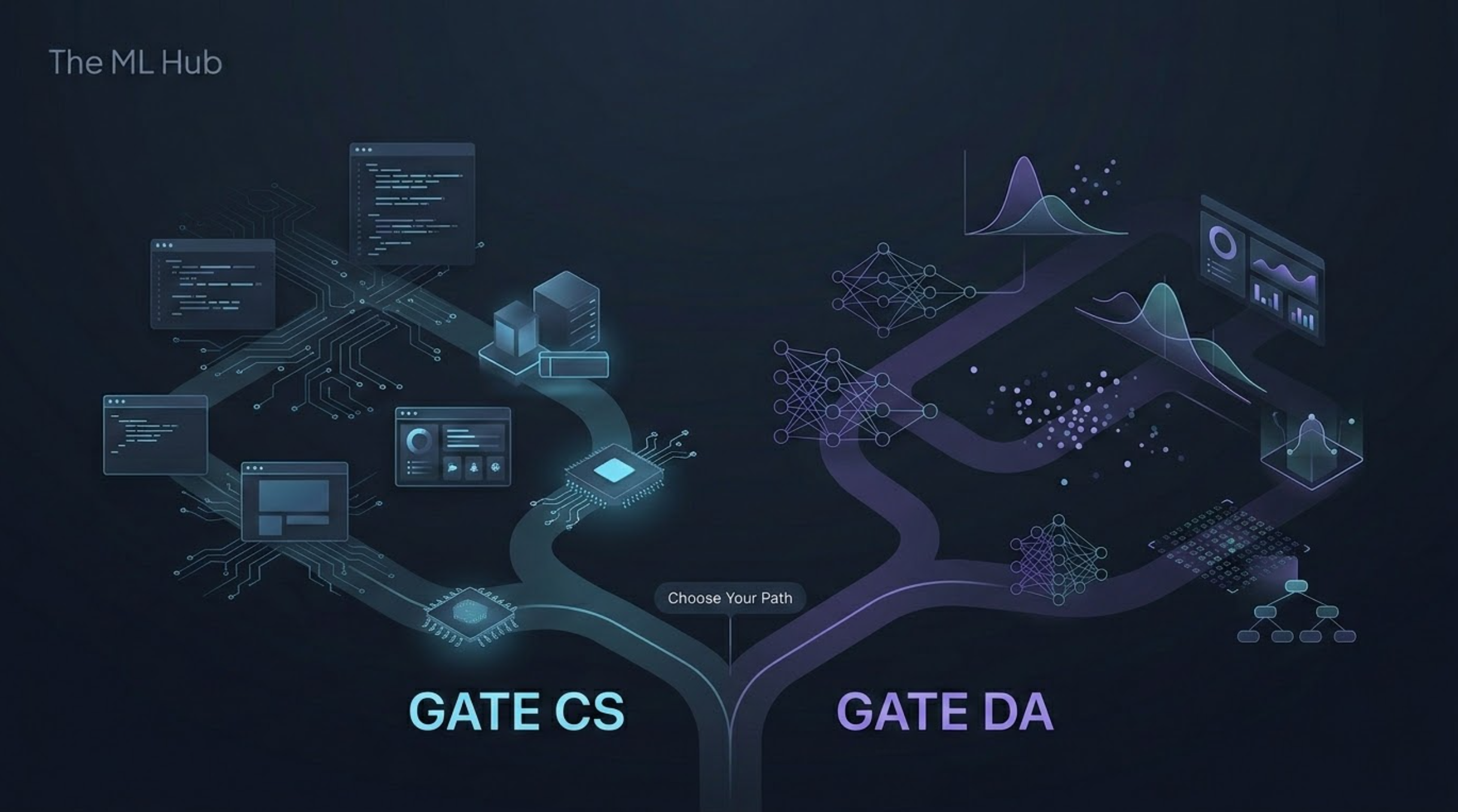
This is one of the most common questions among GATE aspirants. Here is a direct comparison:
| Feature | GATE CS (Computer Science) | GATE DA (Data Science & AI) |
|---|---|---|
| Focus Area | Computer systems, hardware, networking | Data science, ML, AI, statistics |
| Mathematics | Discrete math, calculus, linear algebra | Probability, statistics, linear algebra, optimization |
| Core Topics | OS, networking, compilers, TOC, COA | ML, AI, databases, Python, DSA |
| Programming Language | C | Python |
| Hardware Topics | Digital logic, computer architecture | Not included |
| Career Direction | Systems, backend, infrastructure | Data science, ML engineering, AI research |
| Competition | Very high (large, established candidate pool) | Growing (newer paper, increasing registrations) |
| Syllabus Breadth | Broad — 10+ distinct subject areas | Focused — 7 core areas, math-heavy |
Choose GATE DA if you are interested in data analysis, machine learning, AI research, or data science roles. Choose GATE CS if you prefer systems programming, OS internals, networking, or compiler design.
GATE DA is also a strong option for non-CS students because it does not require knowledge of hardware, operating systems, or compiler theory — subjects that are harder to self-study without a CS background. If you're from an EE or ECE background, see our detailed guide: GATE DA for EE & ECE students.
For a full comparison with verified 2026 data (candidate numbers, cutoffs, syllabus overlap), read our dedicated GATE DA vs GATE CS analysis.
How to Prepare for GATE DA
A structured preparation approach is critical. Based on guidance from The ML Hub mentors — including GATE rankers who scored AIR 6 and AIR 9 in GATE DA — here is a proven phased strategy:
Phase 1: Build Mathematical Foundations (Months 1–3)
- Start with mathematics: Probability & Statistics, Linear Algebra, and Calculus form the prerequisites for ML and AI. Allocate 40% of your early preparation time here.
- Learn Python: Get comfortable with Python syntax, data structures (lists, dictionaries, sets), and basic algorithms. Practice coding daily.
- Cover DBMS basics: ER models, SQL queries, and normalization are scoring and predictable topics.
Phase 2: Core Subjects (Months 4–7)
- Machine Learning & AI: Build on your math foundation. Focus on understanding algorithms conceptually — why a loss function works, not just how to import it.
- Algorithms: Selection, bubble and insertion sort; divide-and-conquer mergesort and quicksort; graph traversals and shortest paths. Use complexity analysis as a supporting skill.
- Subject-wise tests: Take weekly topic tests to identify weak areas early. Do not wait until the end to start testing.
Phase 3: Revision & Mock Tests (Months 8–10)
- Full-length mock tests: Simulate real exam conditions — 3 hours, 65 questions, virtual calculator. Analyze every mistake.
- Previous year papers: Solve at least 3 years of GATE DA papers to understand question patterns.
- Revision: Focus on syllabus gaps and weak areas identified through mock test analysis.
A common mistake is spending too much time on coding and too little on mathematics. GATE DA is an academic exam — it tests mathematical maturity and conceptual depth, not software development skills. You can also practice with official GATE DA previous-year papers (available on the GATE 2027 syllabus page) to understand the question style.
The ML Hub provides a detailed week-by-week study schedule designed by GATE toppers, covering every topic in the GATE DA syllabus. Following a structured roadmap helps you stay consistent and ensures all topics are covered before the mock test phase. For a complete month-by-month breakdown, see How to Prepare for GATE DA in 8 Months.
Why Mock Tests Matter for GATE DA
You cannot prepare for GATE DA by reading alone. Mock tests serve two purposes that books cannot:
- Exam stamina: Sitting for 3 hours and solving 65 technical questions under time pressure is a skill. You need to practice it.
- Weak area identification: Mock tests reveal whether your problem is a specific topic (e.g., eigenvalues) or a general issue like time management or calculation errors.
Daily Practice Problems (DPPs) complement mock tests by reinforcing what you learn each day. Instead of waiting until month-end to test yourself, DPPs force you to apply concepts immediately — which is essential for long-term retention.
At The ML Hub, our GATE DA Test Series — 61 tests with 1,685 problems covering topic-wise, subject-level, multi-subject, and full-length mocks — is designed by IIT Bombay alumni to match the exact interface and difficulty of the actual GATE exam. Our GATE DA toppers consistently credit daily practice and mock test analysis as the key differentiators in their preparation.
Career Paths After GATE DA
A good GATE DA score can support applications to several academic and professional pathways:
M.Tech and M.S. Admissions
GATE DA scores may be accepted for M.Tech/M.S. programs in Data Science, AI, Machine Learning, and related fields at select IITs, IISc, IIITs, and NITs. Candidates should verify program-specific admission criteria, as acceptance of the DA paper can vary by institute and year.
Ph.D. Programs
A high GATE DA score may help candidates apply to Ph.D. programs at research institutions where the DA paper is accepted. This path is suitable if you are interested in working on problems in generative AI, NLP, computer vision, or reinforcement learning. Candidates should verify program-specific criteria.
PSU Recruitment
Some organizations may use GATE scores for technical recruitment, but DA-specific acceptance can vary by role and notification. Candidates should always verify whether the GATE DA paper is accepted for a specific recruitment cycle before relying on it.
Industry Readiness
Even beyond admissions, the skills you develop during GATE DA preparation — statistics, linear algebra, Python, machine learning — are directly relevant to industry roles like Data Scientist, ML Engineer, and AI Researcher. The preparation builds useful foundations, though admission and recruitment depend on institute-specific or organization-specific criteria.
GATE DA for Beginners: How to Start
If you are new to GATE DA and feeling unsure about where to begin, here is a simple starting checklist:
- Understand the exam: Read through this guide and the detailed syllabus breakdown to understand what is tested and how.
- Assess your math level: Can you solve basic probability problems and work with matrices? If not, start with foundational math before anything else.
- Learn Python basics: If you have never coded in Python, spend 2–3 weeks on syntax, loops, functions, and data structures.
- Pick a structured course: Self-study is possible but risky without guidance. A structured program helps you cover the right topics in the right order.
- Start solving problems early: Do not just watch lectures. Solve problems from day one — even if they are easy at first.
- Join a community: Preparing alone is harder. Peer discussion and doubt-solving accelerate learning.
The ML Hub offers a free demo course that lets you experience the teaching style, access sample lectures, and explore the study material before committing to a full program.
Prepare for GATE DA with The ML Hub
The ML Hub's GATE DA program is built by GATE toppers (AIR 6, AIR 9 GATE DA) and IIT Bombay alumni. Our students have secured 20+ top ranks in GATE DA 2026, including AIR 16, AIR 59, AIR 72, and AIR 97.
- Recorded lectures covering the complete GATE DA syllabus
- Weekly live sessions for doubt-solving and problem practice
- Daily Practice Problems (DPPs) aligned with GATE patterns
- 61 tests with 1,685 problems — topic, subject, multi-subject, and full-length mocks
- 1:1 mentorship from GATE rankers and IIT alumni
Explore the GATE DA Course | View the Test Series | View the Study Schedule | Try the Free Demo
Frequently Asked Questions
What is GATE DA?
GATE DA is a paper under the GATE exam that focuses on Data Science and Artificial Intelligence. It tests candidates on mathematics (probability, statistics, linear algebra), programming (Python), machine learning, AI, and databases. It can be used to apply for M.Tech and research programs where the DA paper is accepted.
What is the full form of GATE DA?
GATE DA stands for Graduate Aptitude Test in Engineering — Data Science and Artificial Intelligence. The "DA" specifically refers to the Data Science and AI paper within the broader GATE examination system.
Who is eligible for GATE DA?
Candidates who meet the general GATE eligibility criteria can usually choose the DA paper, subject to official paper-selection rules. This includes students in their 3rd year or higher and graduates from approved degree programs. GATE DA is not restricted to CS/IT students, but candidates should verify the latest official eligibility rules before applying.
What is the GATE DA exam pattern?
GATE DA has 65 questions worth 100 marks, to be completed in 3 hours. Question types include MCQs (with negative marking), MSQs (no negative marking), and NAT questions (no negative marking). General Aptitude carries 15 marks and core subjects carry 85 marks.
Does GATE DA have negative marking?
Yes, but only for MCQs. Wrong answers on 1-mark MCQs attract a penalty of ⅓ mark, and wrong answers on 2-mark MCQs attract ⅔ mark. MSQ and NAT questions have no negative marking.
Is GATE DA harder than GATE CS?
GATE DA is not necessarily harder, but it is more mathematically intensive. GATE CS has a broader syllabus covering systems, hardware, and networking. GATE DA has a focused syllabus but requires deeper understanding of statistics, linear algebra, and ML. The choice depends on your strengths and career goals.
Can I prepare for GATE DA in 6 months?
Yes, many successful candidates have prepared in 6–8 months with a disciplined schedule. The key is starting with mathematics, following a structured study plan, and practicing consistently with mock tests and DPPs. Working professionals can also prepare alongside their job with 2–3 hours of daily study.
Is Python required for GATE DA?
Yes, Python is the only programming language tested in GATE DA. You need to understand Python syntax, data structures, functions, and basic algorithms. Unlike GATE CS which tests C programming, GATE DA uses Python exclusively.
What career options open after GATE DA?
A good GATE DA score can help candidates apply to relevant M.Tech, M.S. and research programs where the DA paper is accepted. The preparation also builds useful foundations for data science, machine learning and AI roles, but admission and recruitment depend on institute-specific or organization-specific criteria.
How can The ML Hub help with GATE DA preparation?
The ML Hub offers a complete GATE DA preparation program with recorded lectures, weekly live sessions, daily practice problems, full-length mock tests, and 1:1 mentorship from GATE toppers and IIT Bombay alumni. Our students secured 20+ top ranks in GATE DA 2026, including AIR 16, AIR 59, AIR 72 and AIR 97. You can try the free demo course to experience the teaching style before enrolling.
Conclusion
GATE DA is a well-designed exam that tests the core skills needed for a career in data science and AI — mathematics, programming, machine learning, and analytical thinking. Whether you are a CS student, an engineering graduate from another branch, or a working professional looking to transition into AI, GATE DA can support applications to relevant postgraduate and research programs where the DA paper is accepted, while also helping you build useful foundations for data science and machine learning roles.
The key to success is structured preparation: build strong mathematical foundations first, master Python and core algorithms, then focus on ML and AI concepts. Combine this with consistent practice using the GATE DA Test Series and you will be well-positioned for a strong score.
For a detailed topic-by-topic syllabus breakdown, read our GATE DA Syllabus 2027 guide. To understand how raw marks translate to your final GATE score, see GATE DA Marks vs Score. For qualifying and admission cutoff data, check the GATE DA Cutoff 2024–2026 page. To start preparing with a proven roadmap, explore the GATE DA course or check out The ML Hub's GATE DA toppers for inspiration from students who have already achieved top ranks. Browse all our GATE DA articles for more preparation resources.