Most students spend months studying algorithms and never build a single working model. Many strong data science resumes are built around hands-on Machine Learning Projects that demonstrate practical skills. For GATE DA aspirants, projects complement theoretical preparation by reinforcing core concepts through application. The World Economic Forum's Future of Jobs Report 2025 lists AI and Machine Learning Specialists among the fastest-growing roles by 2030. This guide gives GATE DA students, GATE CS students, and data science learners a clear, structured path to building projects that matter.
Machine Learning Projects: end-to-end implementations where you take raw data, train a predictive model, evaluate its performance, and present results in a deployable or shareable format. They prove you can apply theory practically, which no exam score alone can demonstrate.
Quick Summary
- Who this is for: GATE DA students, GATE CS aspirants, and data science learners at any experience level
- Beginner projects: House price prediction, spam classifier, iris classification, customer churn, movie recommendations
- Intermediate projects: Loan default prediction, sentiment analysis, medical image classification, stock direction predictor
- Advanced projects: End-to-end fraud detection system, crop yield prediction, fake news detection with BERT
- Python stack: pandas, NumPy, scikit-learn, XGBoost, PyTorch or TensorFlow
- Resume standard: Deployable project + quantified results + clean GitHub README = interview-ready portfolio
What Are Machine Learning Projects and Why Do They Matter?
Machine Learning Projects are end-to-end implementations where you take raw data, train a predictive model, evaluate its performance, and present results in a deployable or shareable format. They prove you can apply theory practically, which no exam score alone can demonstrate.
Hiring managers value applied understanding, while GATE tests your theoretical understanding of the underlying concepts. Machine learning projects help connect both by reinforcing theory through practical implementation. A well-built project shows you know how to clean data, select features, choose algorithms, tune hyperparameters, and interpret results.
Machine learning: a branch of artificial intelligence where systems learn from data to make predictions or decisions without being explicitly programmed.
For GATE DA candidates specifically, building projects directly reinforces core syllabus topics like probability, linear algebra, and classification algorithms. You're not studying twice. You're studying smarter. Check out the ML HUB guide to Machine Learning for GATE DA to see how project work maps directly to exam topics.
Beginner Machine Learning Projects to Start Today
Effective beginner Machine Learning Projects are narrow in scope, use clean public datasets, and produce a measurable output within one to two weeks. Starting small isn't a compromise. It's a strategy.
Here are five proven starting points for students at the beginner level:
- House Price Prediction: Use the Ames Housing dataset or Kaggle House Prices dataset. Apply linear regression, then improve with Ridge or Lasso. This teaches feature engineering and regularization in one project.
- Spam Email Classifier: Build a Naive Bayes or logistic regression classifier on the UCI Spambase dataset. Covers text processing, tokenization, and binary classification.
- Iris Flower Classification: The classic entry point. Use k-nearest neighbors or decision trees. Small dataset, clean structure, fast iteration.
- Movie Recommendation System: Implement collaborative filtering with the MovieLens dataset. Teaches matrix factorization concepts aligned with GATE DA linear algebra topics.
- Customer Churn Prediction: Binary classification on telecom data. Real business context, imbalanced classes, and a strong resume narrative.
Each of these beginner Machine Learning Projects covers at least one core concept from the GATE DA syllabus, including probability and statistics or linear algebra, making your preparation more efficient.
Also Read: Python and DSA for GATE DA: Complete Guide
How Do You Start an ML Project from Scratch?
Start a machine learning project by defining a clear problem statement, sourcing a relevant dataset, and establishing a success metric before writing a single line of code. Skipping this step is why most student projects stall after week one.
Here is a repeatable seven-step framework for starting any ML project:
- Define the problem: Regression, classification, clustering, or recommendation? Write one sentence describing what your model will predict and for whom.
- Source your dataset: Use Kaggle, UCI ML Repository, or open government data. Choose datasets that are large enough to demonstrate the complete ML workflow. Smaller datasets are excellent for learning, while larger datasets provide more realistic portfolio experience.
- Explore the data (EDA): Run descriptive statistics. Check for nulls, outliers, and class imbalance before touching any model.
- Preprocess and engineer features: Normalize numerical columns, encode categoricals, and handle missing values. Data cleaning, preprocessing, and feature engineering often consume a significant portion of an ML project and have a major impact on model performance.
- Choose and train a baseline model: Start simple. Logistic regression or decision tree first. Beat the baseline before adding complexity.
- Evaluate with the right metric: Accuracy misleads on imbalanced data. Use precision, recall, F1-score, AUC-ROC, or RMSE depending on your task.
- Document and share: Push to GitHub with a clear README. Explain your problem, approach, results, and what you'd improve next.
Process tip: Most students jump straight to step five. Steps one through four are where expert ML engineers spend most of their time. Follow the order above and your project quality improves immediately.
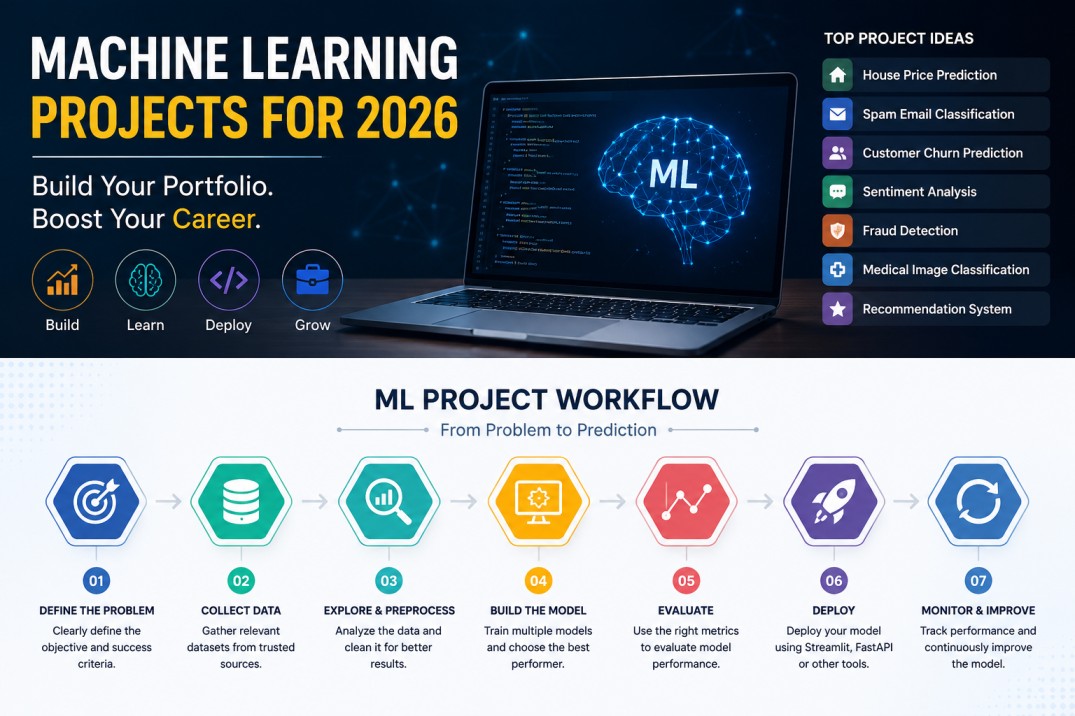
Scikit-learn's official documentation covers nearly every algorithm you'll need for steps five and six, with working code examples for each.
Top Machine Learning Project Ideas for Students in 2026
The strongest machine learning project ideas for students in 2026 combine real-world relevance with technical depth. Projects that solve an observable problem in healthcare, finance, or climate tend to stand out to recruiters and hiring managers.
Here is a curated list organized by difficulty level:
Intermediate Projects (2 to 4 weeks)
- Loan Default Prediction: Classify whether a borrower will default using financial attributes. Use XGBoost or Random Forest. Handle class imbalance with SMOTE. Real-world stakes make this a strong interview talking point.
- Sentiment Analysis on Product Reviews: Build an NLP pipeline using TF-IDF or word embeddings. Train a classifier on Amazon or IMDB review data. Introduces text preprocessing and feature extraction.
- Medical Image Classification: Use a CNN on the chest X-ray dataset from NIH. Trains you in deep learning fundamentals and data augmentation techniques.
- Stock Price Direction Predictor: Predict whether a stock closes higher or lower using technical indicators. Teaches time-series feature engineering and the dangers of data leakage.
- Traffic Volume Forecasting: Time-series regression on public city transport data. Covers lag features, seasonal decomposition, and ARIMA vs. gradient boosting comparisons.
Advanced Projects (4 to 8 weeks)
- End-to-End Fraud Detection System: Simulate a financial institution's pipeline from data ingestion to real-time scoring API. Covers MLOps, model deployment, and monitoring.
- Crop Yield Prediction with Satellite Data: Combine remote sensing data with weather records. Trains spatial feature engineering and ensemble methods.
- Fake News Detection with BERT: Fine-tune a pre-trained transformer model on labeled news articles. Demonstrates state-of-the-art NLP and transfer learning skills.
All of these qualify as impactful AI projects for a portfolio because they show domain knowledge, not just algorithm knowledge. For GATE CS students, the fraud detection and NLP projects also reinforce topics covered in the Artificial Intelligence for GATE DA syllabus.
ML Projects with Python: Tools and Frameworks You Need
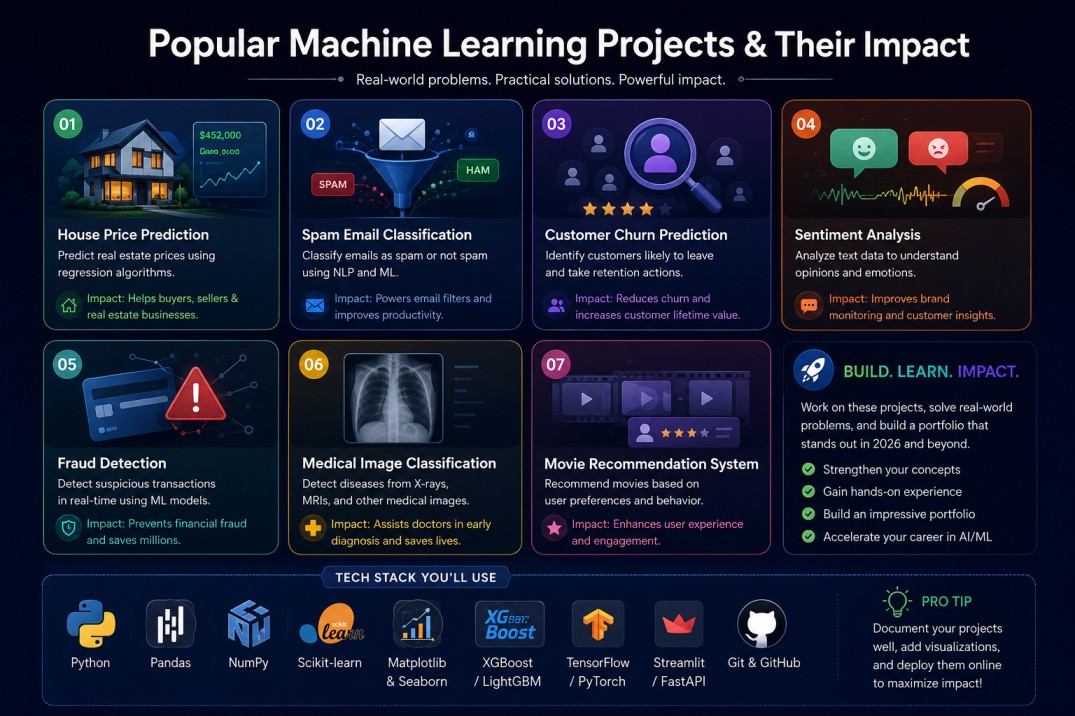
Every serious ML project with Python relies on a consistent stack: pandas for data manipulation, scikit-learn for classical ML, PyTorch or TensorFlow for deep learning, and Matplotlib or Seaborn for visualization. Master these before picking up anything else.
Here is the essential Python ML toolkit for 2026:
| Tool | Purpose | Skill Level |
|---|---|---|
| pandas | Data loading, cleaning, transformation | Beginner |
| NumPy | Numerical computation, array operations | Beginner |
| scikit-learn | Classical ML algorithms, pipelines, metrics | Beginner to Intermediate |
| Matplotlib / Seaborn | Data visualization and EDA | Beginner |
| TensorFlow / PyTorch | Deep learning model training | Intermediate to Advanced |
| XGBoost / LightGBM | Gradient boosting for tabular data | Intermediate |
| FastAPI / Flask | Model deployment as an API | Intermediate |
| MLflow | Experiment tracking and model registry | Advanced |
Python is the most widely used programming language for machine learning, valued for its rich ecosystem, extensive libraries, strong community support, and widespread adoption in both academia and industry. Building your projects in Python ensures broad compatibility with academic benchmarks and industry environments.
For GATE DA students who need to strengthen their Python foundations alongside project work, the Python and DSA for GATE DA guide covers the coding skills you'll need before tackling complex project pipelines.
Why Real-World Machine Learning Applications Make the Best Portfolio Pieces
Real-world machine learning applications tend to be stronger portfolio pieces than toy projects in many professional contexts because they require you to handle messy data, conflicting constraints, and business-level decision-making.
Consider two candidates. One built a linear regression model on a clean academic dataset and reported 92% accuracy. The other built a churn prediction tool for a simulated telecom company, handled 30% missing values, deployed it as a REST API, and documented its business impact in lost revenue terms. The second candidate is often more compelling because the project demonstrates practical problem-solving and deployment skills.
Real-world Machine Learning Projects also help develop non-algorithmic skills that many textbooks don't cover: stakeholder communication, trade-offs between model interpretability and accuracy, and the cost of wrong predictions in business terms. These are the skills that make senior engineers valuable.
Domain alignment matters too. If you're targeting a healthcare ML role, your portfolio should include medical data projects. Targeting fintech? Fraud detection and credit scoring projects. The portfolio signals intent, not just competence.
Also Read: Best Online Courses for GATE DA Preparation
Data Science Projects for Resume 2026: What Actually Works
The data science projects that move resumes to the top of the pile in 2026 are deployable, documented, and domain-specific. A GitHub link to a Jupyter notebook is not enough. A live demo, a clear problem statement, and quantified results are the minimum bar.
Here is a checklist for each project before you add it to your resume:
- Problem statement is one clear sentence
- Dataset source is named and linked
- Model performance is reported with a relevant metric (not just accuracy)
- Results are interpreted in business or human terms, not just numbers
- Code is clean, commented, and on GitHub with a descriptive README
- A live demo, Streamlit app, or API endpoint exists if applicable
- You can explain every decision you made in a five-minute verbal walkthrough
For GATE DA students, project documentation also serves as excellent revision material. Writing down why you chose a particular algorithm can reinforce conceptual understanding more effectively than simply re-reading a textbook section.
If you want to see curated project templates and guided project tracks built specifically for GATE DA and data science careers, explore the ML HUB Projects page for structured, mentored project pathways.
Information Gain: Two Things Most ML Project Guides Miss
Standard ML project lists tell you what to build. They almost never tell you how to sequence your learning or how to avoid two common portfolio mistakes that can weaken a candidate's overall application.
The Sequencing Problem
Most students pick projects based on interest, then hit a wall when a project requires a skill they haven't built yet. The fix is to sequence projects by skill dependency, not by topic interest. Build your first three projects in this order: tabular classification, then regression with feature engineering, then an NLP or image task. This sequence ensures each project teaches a new skill layer without leaving gaps.
The Documentation Trap
The second missed insight is that undocumented projects are invisible projects. Recruiters often review project repositories quickly, making a well-written README and clear documentation especially valuable. Write your README for a non-technical reader and include screenshots of outputs. Clear documentation makes projects easier to understand and often leaves a stronger impression than an undocumented project.
For GATE DA students, documentation also doubles as a study log. Writing explanations of your model choices is essentially active recall for exam preparation. Research consistently shows that retrieval practice produces stronger long-term retention than passive re-reading (Karpicke & Blunt, Science, 2011).
Key Takeaways
- Machine Learning Projects are one of the most effective ways to bridge theory and employability for GATE DA, GATE CS, and data science students in 2026.
- Start with beginner projects like spam classifiers or house price predictors to build confidence before tackling advanced pipelines.
- Follow a seven-step framework: define the problem, source data, run EDA, preprocess, train a baseline, evaluate with the right metric, then document and share.
- The Python ML stack in 2026 centers on pandas, scikit-learn, XGBoost, and either PyTorch or TensorFlow for deep learning tasks.
- Real-world, domain-specific projects tend to be stronger than academic toy projects in many professional evaluation contexts, including technical interviews and portfolio reviews.
- A project is only complete when it has a clear problem statement, measurable results, clean code on GitHub, and a readable README.
- Structured project learning aligned to the GATE DA syllabus accelerates both exam preparation and career readiness simultaneously.
Ready to Build ML Projects with Structured GATE DA Preparation?
Start with the structured GATE DA preparation program at ML HUB — designed specifically to cover every topic tested in GATE DA with the depth that top IIT programs and data science companies expect.
Explore the GATE DA 2027 Course | View the Test Series | View the Study Schedule | Try the Free Demo
FAQs
What are the best machine learning projects for beginners?
Beginners should start with house price prediction using linear regression, spam email classification with Naive Bayes, or iris flower classification with decision trees. These projects use clean public datasets, produce clear outputs, and cover core ML concepts like supervised learning, feature engineering, and model evaluation without requiring deep learning knowledge.
How do I start a machine learning project with Python?
Start by defining one specific prediction problem, then source a relevant dataset from Kaggle or UCI ML Repository. Install pandas, NumPy, scikit-learn, and Matplotlib. Run exploratory data analysis first, build a simple baseline model, evaluate with the right metric for your task, and document everything in a GitHub README before considering the project complete.
Which machine learning projects are best for a data science resume in 2026?
The strongest resume projects are deployable and domain-specific. Fraud detection, sentiment analysis, medical image classification, and churn prediction all demonstrate real-world thinking. Add a live Streamlit demo or REST API endpoint to any project. Quantify results in business terms, not just model accuracy, and your resume immediately separates from the majority of applicants.
What machine learning projects should GATE DA students build?
GATE DA students benefit most from projects that reinforce syllabus topics. Build a classification project to apply probability and Bayes' theorem, a regression project to practice linear algebra and optimization, and a clustering project to understand unsupervised learning. Each project directly maps to GATE DA exam concepts and builds practical coding skills simultaneously.
How long does it take to complete a machine learning project?
A beginner project takes one to two weeks if you dedicate two hours per day. An intermediate project like sentiment analysis or fraud detection takes two to four weeks. Advanced projects involving deep learning, deployment, or real-time APIs take four to eight weeks. Don't rush timelines. A well-documented intermediate project is often more impressive than a rushed advanced one.
What Python libraries do I need for ML projects?
The essential stack is pandas for data manipulation, NumPy for numerical operations, scikit-learn for classical algorithms, and Matplotlib or Seaborn for visualization. Add XGBoost or LightGBM for tabular competitions. For deep learning, use PyTorch or TensorFlow. For deployment, learn FastAPI or Streamlit. You don't need all of these at once. Add them as each project demands.
Are machine learning projects important for GATE exam preparation?
Machine learning projects reinforce GATE DA syllabus topics in a way that passive reading cannot. Building a classification model forces you to apply probability theory. A regression project makes linear algebra tangible. Many students find that combining structured project work with syllabus study improves conceptual clarity by reinforcing theoretical concepts through practical implementation.